In the highly competitive world of soap manufacturing, raw material costs are the single largest variable in determining profitability. Every percentage point of cost reduction at the formulation stage — without compromising finished product quality — translates directly into margin improvement and pricing flexibility in a market where competition is fierce and consumer price sensitivity is high. This is precisely why CFAD has become one of the most strategically important ingredients in modern soap noodles manufacturing, and why procurement teams at soap producers across Asia, Africa, the Middle East, and Latin America are paying close attention to CFAD price, CFAD suppliers, and the evolving role of this material in large-scale soap formulation.

What Is CFAD?
CFAD — Coconut Fatty Acid Distillate — is a by-product generated during the physical refining of crude coconut oil. When crude coconut oil undergoes steam distillation as part of the refining process to produce RBD coconut oil, the volatile fatty acid fraction removed in the distillation step is collected as CFAD. It is a complex mixture of free fatty acids — predominantly lauric acid (approximately 45–50%), myristic acid (16–20%), caprylic acid, capric acid, palmitic acid, and oleic acid — along with minor quantities of unsaponifiable matter including tocopherols, sterols, and other naturally occurring coconut oil components.
As a CFAD chemical, it is closely related to coconut oil in its fatty acid profile but differs fundamentally in its physical form — it is predominantly composed of free fatty acids rather than triglycerides. This distinction is critically important for soap manufacturing, where free fatty acids are directly saponifiable and can be incorporated into soap formulations with high efficiency and minimal processing complexity.
CFAD is produced primarily in the Philippines, Indonesia, India, and Sri Lanka — the world's leading coconut oil processing nations — and is traded globally as an industrial oleochemical input. CFAD suppliers in these regions export substantial volumes to soap manufacturers across developing and emerging markets where cost-effective fatty acid inputs are in high demand.
Read Our Article
Growing Demand for Laundry Soap Noodles: Global Market InsightsThe Role of Soap Noodles in Global Soap Manufacturing
Before examining CFAD's specific role, it helps to understand the soap noodles manufacturing process and why raw material selection at this stage is so consequential.
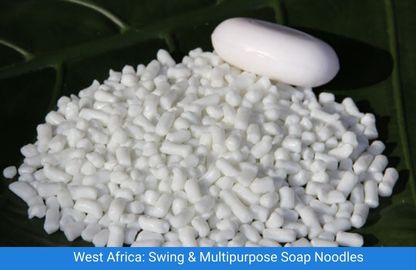
Soap noodles are the semi-finished intermediate product from which finished bar soaps, toilet soaps, laundry soaps, and hotel amenity soaps are produced. They are manufactured through the saponification of fatty acid feedstocks with caustic soda (sodium hydroxide) — a reaction that converts triglycerides or free fatty acids into soap (sodium salts of fatty acids) and glycerol. The resulting soap mass is dried, refined, and extruded into noodle form for onward sale to soap finishing operations.
The fatty acid feedstock composition used in soap noodles manufacturing directly determines the quality characteristics of the finished soap — its lathering performance, hardness, skin feel, cleansing efficacy, and shelf life. Formulators balance multiple fatty acid inputs — typically including palm stearin, palm kernel oil or its derivatives, tallow, and coconut oil-derived materials — to achieve the target soap specification at the lowest possible raw material cost.
This is where CFAD uses in soap noodles manufacturing become highly relevant.
Why CFAD Is Valuable in Soap Noodles Formulation
High Lauric Acid Content Drives Lathering Performance
The most important functional contribution of CFAD to soap noodles formulation is its high lauric and myristic acid content. Lauric acid (C12) and myristic acid (C14) are the fatty acids primarily responsible for lather generation in soap — particularly the abundant, quick-forming foam that consumers associate with effective cleansing. Without adequate lauric and myristic acid content, soap bars produce poor lather, which is one of the most common consumer complaints and a leading driver of brand switching in price-sensitive markets.
CFAD delivers this lauric-myristic acid contribution at a significantly lower cost than refined coconut oil or fractionated coconut fatty acids — making it the most cost-efficient route to achieving target lathering performance in a soap noodles formulation. This is the core of its value proposition for CFAD uses in soap manufacturing: equivalent functional performance at lower cost.
Free Fatty Acid Form Simplifies Saponification
Because CFAD is predominantly composed of free fatty acids rather than triglycerides, it saponifies more rapidly and completely than triglyceride-form coconut oil inputs. In soap noodles manufacturing, this translates to faster reaction times, lower caustic soda consumption per unit of soap produced, and reduced energy requirements during the saponification step. For large-scale soap noodles manufacturers running continuous saponification lines, these processing efficiencies contribute meaningfully to overall plant economics — reinforcing the cost-effectiveness argument for CFAD incorporation.
Cost Advantage Over RBD Coconut Oil
CFAD price is consistently lower than RBD coconut oil price on a fatty acid equivalent basis. Since CFAD is a refining co-product — a by-product of RBD coconut oil production — it carries a lower market value per tonne despite delivering a similar fatty acid profile for saponification purposes. For soap noodles manufacturers seeking to optimise raw material costs, substituting a portion of their RBD coconut oil input with CFAD — where formulation specifications allow — directly reduces the cost of goods without requiring changes to the saponification process or finished product performance.
The CFAD price differential versus refined coconut oil typically ranges from 10–25% depending on market conditions, origin, and grade — a meaningful saving when multiplied across the large volumes consumed by industrial soap manufacturing operations.
Compatibility With Standard Soap Formulation Blends
CFAD integrates seamlessly into standard soap noodles formulation blends alongside palm stearin, palm kernel fatty acids, tallow, and other conventional soap fatty acid inputs. It does not require special handling equipment or process modifications beyond those already standard in soap manufacturing plants. This ease of incorporation — with no capital investment required — makes CFAD adoption straightforward for soap noodles manufacturers already operating established production lines.
Our Other Products
Distilled Fatty AcidsCFAD Price Dynamics and Market Sourcing
For procurement managers evaluating CFAD suppliers, understanding CFAD price dynamics is essential for effective sourcing strategy.
CFAD price is fundamentally linked to crude coconut oil pricing — since the volume and quality of CFAD produced at any refinery is a direct function of the crude coconut oil being processed. When coconut oil prices rise, CFAD prices typically rise in parallel, though the co-product discount to refined coconut oil tends to widen during periods of high crude prices as refiners seek to move co-product volumes.
Key factors influencing CFAD price in 2026 include coconut copra production volumes in the Philippines and Indonesia, competing demand from oleochemical processors and biodiesel producers who also consume CFAD as a feedstock, and global shipping and logistics costs that affect the landed price for buyers importing from Southeast Asian origins.
When evaluating CFAD suppliers, procurement teams should assess the following:
Quality Consistency: Free fatty acid content, moisture levels, colour, and iodine value should be specified and verified against Certificate of Analysis documentation for each shipment. Inconsistent CFAD quality — particularly elevated moisture or colour — can affect saponification efficiency and finished soap quality.
Supply Reliability: CFAD is a co-product, meaning its availability at any given CFAD manufacturer or refinery is tied to their primary RBD coconut oil production volumes. Buyers should confirm that their chosen CFAD supplier has sufficient and consistent refining throughput to support their volume requirements year-round.
Packaging and Logistics: CFAD is typically shipped in bulk liquid form — flexi-tanks, ISO containers, or tanker truck for domestic supply — or in drums for smaller volumes. Confirming appropriate packaging, temperature management during transit, and port of loading logistics is essential when working with international CFAD suppliers.
CFAD vs. PFAD in Soap Noodles: The Comparison Buyers Make
A comparison that frequently arises in soap noodles procurement discussions is CFAD vs. PFAD — Palm Fatty Acid Distillate — which is a competing co-product input used in soap formulations. Both are fatty acid distillates from vegetable oil refining, but they have fundamentally different fatty acid profiles and consequently different functional contributions to soap performance.
PFAD is palmitic and oleic acid-dominant — contributing hardness and conditioning to soap formulations. CFAD is lauric and myristic acid-dominant — contributing lathering and cleansing performance. In practice, the two materials are complementary rather than interchangeable: many soap noodles manufacturers use both in their formulations, balancing PFAD for structure and hardness with CFAD for foam and cleansing, alongside other inputs to achieve target specifications.
The cost comparison between the two is therefore not straightforward — they serve different functional roles, and the economics of substitution depend on the specific formulation target and the prevailing price differential between CFAD and PFAD at any given time.
Geographic Demand Centres: Where CFAD Is Most Widely Used
CFAD consumption in soap noodles manufacturing is most concentrated in regions where high-volume, cost-competitive soap production is a priority and where consumer markets value lathering performance in affordable bar soaps.
South and Southeast Asia — particularly India, Bangladesh, Vietnam, and Indonesia — represent the largest regional consumption base for CFAD in soap manufacturing. India's enormous domestic soap market, served by both large multinationals and thousands of regional soap producers, absorbs significant CFAD volumes annually. Bangladesh's growing soap export industry has similarly become an important demand centre.
Africa — particularly West Africa and East Africa — is a rapidly growing market for CFAD-containing soap noodles, driven by population growth, rising hygiene awareness, and expanding local soap manufacturing capacity in countries including Nigeria, Ghana, Kenya, Ethiopia, and Tanzania. African soap manufacturers overwhelmingly target the economy and mid-range segments where CFAD's cost advantage is most valuable.
Middle East soap manufacturers — particularly in Egypt, Turkey, Iran, and the Gulf states — consume CFAD both as a direct input and via imported soap noodles that incorporate CFAD in their formulation. The region's large halal soap market requires halal-certified fatty acid inputs, making halal-certified CFAD from established CFAD suppliers in the Philippines and Indonesia particularly well-positioned for this demand.
Latin America — Brazil, Mexico, Colombia, and Argentina — represents an emerging growth market for CFAD in soap noodles, as regional soap manufacturers seek to optimise formulation costs in the face of competitive pressure from imported finished soaps and private label expansion by major retailers.
Our Other Products
Surfactants
Conclusion: CFAD as a Strategic Raw Material in Soap Noodles Manufacturing
CFAD has earned its place as one of the most strategically valuable cost-optimisation tools available to soap noodles manufacturers globally. Its combination of high lauric acid content — delivering the lathering performance that consumers demand — with a consistently lower CFAD price relative to refined coconut oil inputs makes it a compelling formulation choice for producers targeting the economy, mid-range, and even certain premium soap segments.
For procurement teams, the key to unlocking CFAD's full value lies in working with reliable CFAD suppliers who can deliver consistent quality, verified origin documentation, appropriate certifications, and competitive pricing backed by genuine supply chain transparency. As raw material cost pressures continue to intensify across the global soap manufacturing industry in 2026 and beyond, CFAD's role as a cost-effective, functionally valuable formulation additive is only set to grow.