

Cocoa Butter Alternatives: What Every Confectionery Manufacturer and Bulk Buyer Needs to Know
Cocoa butter is the defining fat in real chocolate, but its price volatility and supply constraints have made cocoa butter alternatives an essential consideration for confectionery manufacturers worldwide. Whether you are a compound chocolate producer sourcing Cocoa Butter Substitute (CBS), a premium chocolate maker evaluating Cocoa Butter Replacer (CBR), or a food technologist assessing Cocoa Butter Equivalent (CBE) for an artisan product line, understanding the differences between these vegetable fat options is fundamental to making the right formulation and procurement decisions. This article breaks down each category of cocoa butter alternative, explains the technical and regulatory distinctions that govern their use, and identifies the global markets and supply chain factors that determine pricing and availability for bulk buyers.

What Are the Main Alternatives to Cocoa Butter Used in Confectionery Manufacturing?
Cocoa butter is one of the most important fats in food manufacturing, providing the characteristic snap, smooth melt, and glossy appearance of real chocolate. However, its price volatility, limited supply from cocoa-growing regions, and technical challenges in tempering have driven food manufacturers globally to adopt cocoa butter alternatives that can replicate these functional properties at lower cost and with greater supply chain flexibility. The three principal categories of substitutes for cocoa butter are Cocoa Butter Substitute (CBS), Cocoa Butter Replacer (CBR), and Cocoa Butter Equivalent (CBE). Each performs differently in formulation and is subject to different regulatory frameworks depending on the market. Cocoa butter blends combining two or more vegetable fat fractions are also widely used in compound coating and filling applications where precise tempering is either undesirable or commercially impractical.
What Is a Cocoa Butter Substitute (CBS) and How Is It Made?
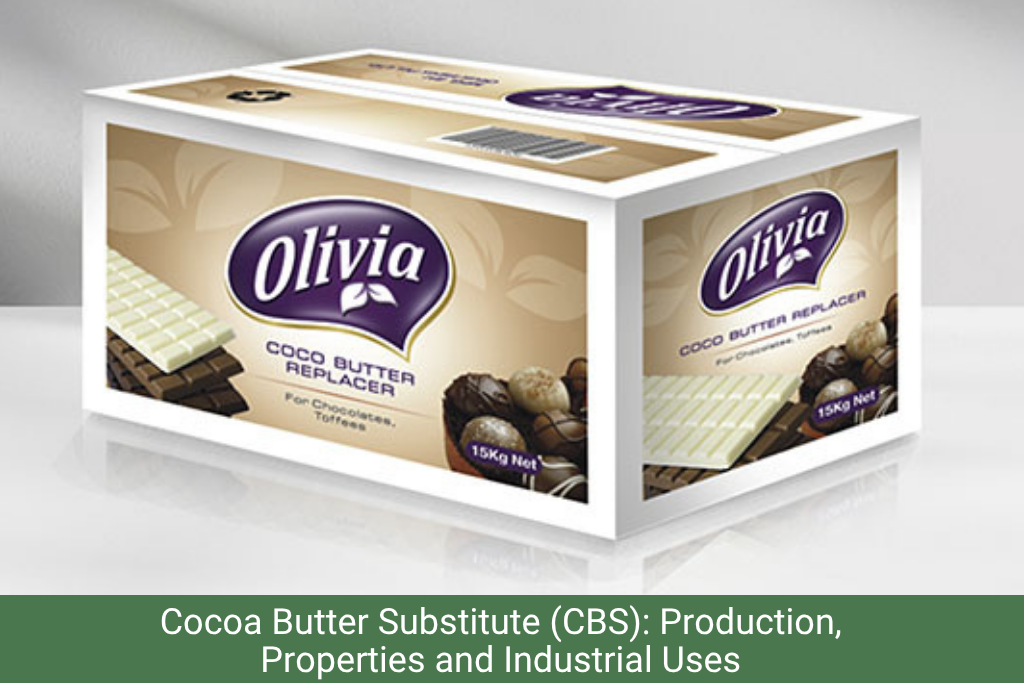
A Cocoa Butter Substitute is a non-tempering lauric fat manufactured primarily from Hydrogenated Palm Kernel Oil (HPKO) or hydrogenated coconut oil. The lauric acid backbone of palm kernel and coconut oil fractions, after full hydrogenation and fractionation, produces a fat with a sharp melting profile close to body temperature and a crystallisation behaviour that does not require tempering in a chocolate processing line. This makes CBS the preferred fat for high-speed, large-volume compound chocolate, coatings, and enrobing applications in Asia, Africa, and the Middle East where tempering infrastructure is limited. Cocoa butter substitute manufacturers in Southeast Asia produce CBS from Hydrogenated Palm Kernel Stearin as the primary raw material, and Singapore-based exporters such as Olivia Oleo supply CBS-compatible feedstocks - including HPKO and RBD Palm Kernel Oil - to compound chocolate producers across more than 30 countries. The key technical requirement for a cocoa butter substitute is a Slip Melting Point (SMP) of approximately 34 to 36 degrees Celsius, and a Solid Fat Content (SFC) profile that mirrors the sharp melt of cocoa butter without the polymorphic instability that makes tempering necessary.
What Is a Cocoa Butter Replacer (CBR) and When Is It Preferred Over CBS?
A Cocoa Butter Replacer is a non-lauric vegetable fat typically derived from hydrogenated palm oil or partially hydrogenated soybean and rapeseed oils, designed to replace a portion of cocoa butter in formulations that must comply with regulations limiting non-cocoa butter vegetable fats. In markets where food law permits up to 5 percent vegetable fat in chocolate without losing the designation as chocolate (as in the European Union under Directive 2000/36/EC), a CBR based on non-lauric fats is the technically appropriate choice. Unlike CBS, a Cocoa Butter Replacer is compatible with cocoa butter at moderate blending levels and does not cause the eutectic softening that lauric CBS creates when mixed with real cocoa butter above 5 to 10 percent. Cocoa Butter Replacer manufacturers supply this fat primarily to premium confectionery producers and chocolate manufacturers operating in regulated markets where the product's legal definition as chocolate must be maintained. For bulk buyers and importers seeking a Cocoa Butter Replacer Supplier or exporter, it is important to verify the precise fat composition, the trans fat content if hydrogenated vegetable oils are used, and the compliance documentation required in the destination market.
Our Other Products
Soap Noodles - SWSN, MSN, LSNWhat Is Cocoa Butter Equivalent (CBE) and How Does It Differ from CBS and CBR?
A cocoa butter equivalent is the most chemically precise of the three alternative categories. It is specifically designed to match the triglyceride composition of genuine cocoa butter - dominated by POP, POSt, and StOSt triglycerides - so that it is physically miscible with cocoa butter at any ratio without altering the crystallisation behaviour. CBE is produced from specific palm oil fractions (mid-fraction), shea, illipe, sal, and other exotic fats that are enzymatically interesterified to achieve the target triglyceride profile. Because CBE is compositionally equivalent to cocoa butter, it can be used in chocolate at any level in markets that permit it (such as the EU countries that allow up to 5% total vegetable fat) without requiring any separate labelling. It is the premium option in the cocoa butter alternatives market and commands a price premium that reflects its complex manufacturing process. For food manufacturers requiring maximum compatibility with genuine cocoa butter in artisan or premium product lines, CBE represents the technically optimal cocoa butter replacement.
How Do CBS, CBR, and CBE Compare for Different Confectionery Applications?
| Parameter | CBS (Lauric) | CBR (Non-Lauric) | CBE |
|---|---|---|---|
| Primary feedstock | HPKO / Hydrogenated Coconut Oil | Hydrogenated Palm Oil / Soybean | Palm Mid-Fraction, Shea, Sal |
| Tempering required | No | No | Yes, same as cocoa butter |
| Compatible with real cocoa butter | Below 5% only | Up to 20–30% | Any ratio |
| Trans fat content | Low, fully hydrogenated | Moderate to high if partially hydrogenated | None |
| Snap and gloss | Excellent | Good | Excellent |
| Melt profile | Sharp, clean | Moderate | Matches cocoa butter precisely |
| Typical use | Compound coatings, enrobing, fillings | Chocolate biscuit coatings, fillers | Premium chocolate, artisan confectionery |
| Regulatory status (EU) | Not permitted in labelled chocolate | Not permitted in labelled chocolate | Permitted up to 5% in EU chocolate |
Which Markets Are the Largest Importers of Cocoa Butter Substitutes and Replacers?
The cocoa butter alternatives market is concentrated in two primary demand regions. Asia Pacific, led by Indonesia, India, China, Malaysia, and the Philippines, is the world's largest consumer of Cocoa Butter Substitute because the majority of compound chocolate and confectionery coating produced in the region uses non-tempering CBS for cost and operational reasons. The US cocoa butter alternatives market is the second major segment, where compound chocolate and candy coatings dominate large-scale confectionery manufacturing. Africa represents the fastest-growing import segment for CBS and CBR due to the expansion of local confectionery and bakery manufacturing in Nigeria, Ethiopia, Kenya, and South Africa, driven by a growing middle-class consumer base. Bulk buyers, importers, and Cocoa Butter Substitute Wholesale purchasers in these markets source primarily from Southeast Asian producers, with Singapore serving as a key re-export and trading hub for quality-certified CBS feedstocks and finished fat products. Olivia Oleo supplies the HPKO and palm kernel stearin raw materials that CBS producers depend on, as well as finished specialty fats to confectionery manufacturers across Africa, the Middle East, and South and Southeast Asia.
What Quality Parameters Should Bulk Buyers Check When Sourcing CBS or CBR?
For Cocoa Butter Substitute Suppliers and Cocoa Butter Replacer Suppliers supplying to the food industry, buyers should request a full Certificate of Analysis before accepting any shipment. Cocoa Butter Substitute Exporters shipping to markets with Halal requirements must also provide a valid Halal certificate from an accredited certifying body, as the palm kernel and coconut feedstocks used in CBS production are inherently plant-derived but the process aids and equipment cleaning agents must also be verified as compliant.

How Does Palm Kernel Oil Supply Chain Affect CBS Pricing and Availability?
As a cocoa butter substitute producer or large-scale user of CBS, understanding the supply chain upstream of CBS production is essential for procurement planning. The cost of CBS is primarily driven by the price of RBD Palm Kernel Oil and Hydrogenated Palm Kernel Oil, both of which move in correlation with the Malaysian and Indonesian palm kernel market. When palm kernel demand for lauric acid and soap manufacturing increases, CBS feedstock costs rise. Singapore, as a major trading hub for palm kernel derivatives, provides buyers and Cocoa Butter Substitute Exporters with price transparency and logistical efficiency that factory-direct purchases from Indonesian or Malaysian mills may not offer. Olivia Oleo's position as a bulk exporter of both HPKO and RBD Palm Kernel Oil allows confectionery manufacturers and CBS producers to source their critical feedstocks through a single supplier channel with consistent quality, certification, and on-time delivery.
Our Other Products
Distilled Fatty AcidsSourcing Cocoa Butter Alternatives: Make the Right Call for Your Confectionery Application
Choosing the right cocoa butter alternative, whether CBS from Hydrogenated Palm Kernel Oil for non-tempering compound coatings, CBR for EU-compliant chocolate formulations, or CBE for premium artisan chocolate, depends on a precise match between the fat's technical properties and the demands of your production process and target market. The CBS and CBR market is concentrated in Asia Pacific, Africa, and North America, with Singapore serving as a key hub for quality-certified palm kernel derivative feedstocks. Olivia Oleo's position as a bulk exporter of RBD Palm Kernel Oil and HPKO provides confectionery manufacturers and CBS producers with a reliable, fully documented supply channel for these critical feedstocks. For quality parameters, certification requirements, and competitive pricing on cocoa butter substitute and cocoa butter replacer feedstocks, contact the Olivia Oleo team directly.