

Objective:
This article provides an in-depth overview of Distilled Fatty Acids, focusing on the production processes, key differences between palm oil-based and palm kernel oil-based DFA and their industrial relevance. It aims to highlight the significance of fatty acid composition, purification methods and quality parameters, shedding light on how these factors impact the applications of DFA in various industries such as soap manufacturing, cosmetics and lubricants.

Distilled Fatty Acid and How It Is Derived from Palm & Palm Kernel Oil
Distilled Fatty Acids are a purified form of fatty acids obtained through distillation, typically derived from sources like palm oil, palm kernel oil or coconut oil. In the case of palm-based fatty acids, these are usually extracted from Palm Fatty Acid Distillate or Palm Kernel Fatty Acid Distillate, which are by-products of refining crude palm oil and palm kernel oil.
The derivation of DFA begins with the extraction of crude palm oil or palm kernel oil, followed by refining to remove impurities. The next step involves distillation, where fatty acids are separated based on their boiling points, resulting in highly Distilled Palm Kernel Fatty Acid. These refined products are then used in a variety of industrial applications, including soaps, cosmetics and lubricants.
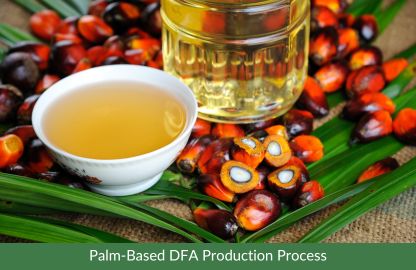
Production Process of Palm-Based DFA: From Crude Oil to Distilled Fatty Acid
The production of Palm-Based Distilled Fatty Acid begins with extracting crude palm oil from the oil palm fruit. The crude oil is then refined through a series of processes like degumming, deacidification and decolorization to remove impurities. Once the oil is refined, it undergoes distillation, where Palm Fatty Acid Distillate is produced. This rich in fatty acids, is subjected to further refining and distillation, separating fatty acids into high-purity fractions.
Similarly, Distilled Palm Kernel Fatty Acid is produced by extracting oil from palm kernels, followed by refining and distillation to separate fatty acids, which are then purified further to create Distilled Fractionated Fatty Acids.
Key Differences Between Palm Oil-Based DFA and Palm Kernel Oil-Based DFA
While both Palm Oil-Based DFA and Palm Kernel Oil-Based DFA are derived from different parts of the oil palm, they have distinct fatty acid compositions. Palm Oil-Based DFA is higher in oleic acid and linoleic acid, making it more unsaturated. This makes it ideal for applications requiring unsaturated fatty acids, such as in cosmetics and personal care products.
In contrast, Palm Kernel Oil-Based DFA is richer in saturated fatty acids like lauric acid, which provides greater stability at higher temperatures. These properties make Palm Kernel Oil-Based DFA more suitable for use in products like detergents and solid soaps that require enhanced stability and performance at elevated temperatures.
Understanding Fatty Acid Composition in Palm & Palm Kernel DFA
The fatty acid composition of Palm and Palm Kernel DFA differs significantly, which affects their industrial uses. Distilled Palm Fatty Acids generally have higher amounts of oleic acid and linoleic acid, making them more fluid and unsaturated. On the other hand, Distilled Palm Kernel Fatty Acids are richer in saturated fatty acids like lauric acid and myristic acid, contributing to their stability at room temperature and their suitability for solid applications such as soaps.
These differences in fatty acid composition make Palm and Palm Kernel DFA versatile raw materials for various industrial applications, influencing properties such as melting point, reactivity and shelf life.
Role of Fractionation and Distillation in DFA Purification
Fractionation and distillation are critical processes for the purification of DFA. Fractionation is used to separate fatty acid mixtures based on their melting points, resulting in different fatty acid fractions, which are known as Distilled Fractionated Fatty Acids. This process is particularly useful in producing high-quality, targeted fatty acid products for specific applications.
Distillation, on the other hand, separates fatty acids based on their boiling points, yielding highly purified such as Distilled Palm Fatty Acid Distillate. These purified fractions are essential for industrial uses that demand high standards of purity and consistency.
Physicochemical Properties of Palm-Based DFA and Their Industrial Relevance
The physicochemical properties of Palm-Based DFA, such as melting point, iodine value, saponification value and acid value, are crucial in determining their suitability for industrial applications. Distilled Palm Fatty Acid tends to be more fluid and less dense, making it ideal for liquid formulations, including soaps and shampoos. Distilled Palm Kernel Fatty Acid, being more solid at room temperature, is better suited for use in solid soaps and products requiring greater stability.
These properties play a significant role in the performance and shelf life of industrial products, making the right choice of DFA essential for ensuring product quality and stability.
Comparative Study: Palm DFA vs. Tallow-Based DFA in Soap Manufacturing
Both Palm-Based DFA and Tallow-Based DFA are commonly used in soap manufacturing. However, Palm-Based DFA, such as Distilled Palm Fatty Acid Distillate, generally results in softer soaps, while Tallow-Based DFA, derived from animal fat, produces harder soaps.
Palm DFA is derived from renewable plant sources, whereas tallow is animal-derived. Palm-based products, such as Distilled Palm Fatty Acid Distillate, are also more consistent in quality, making them a preferred choice for soap manufacturers seeking high-quality, plant-based ingredients in their formulations.
Quality Parameters and Testing Methods for Palm-Based Distilled Fatty Acids
To ensure the quality and consistency of Palm-Based Distilled Fatty Acids (DPFA), various quality parameters are measured, including:
- Acid Value: Reflects the free fatty acid content, with lower values indicating higher purity.
- Saponification Value: Measures the amount of alkali needed to saponify the fat, providing insight into its fatty acid profile.
- Iodine Value: Indicates the degree of unsaturation in the fatty acids, which is important for determining the reactivity and stability of the oil.
These testing methods ensure that the Distilled Fatty Acid products meet the required standards for industrial applications, whether for food, cosmetics or manufacturing.
Impact of Feedstock Quality on DFA Yield and Purity
The quality of the feedstock used in DFA production has a significant impact on the yield and purity of the final product. High-quality palm oil and palm kernel oil, which have minimal impurities, yield higher quantities of pure Distilled Fatty Acids. On the other hand, poor-quality feedstock with higher levels of impurities or free fatty acids may result in lower yields and reduced purity.
Using high-quality feedstock ensures a more efficient distillation process and higher-quality DFA products, which are essential for applications that require high purity, such as in cosmetics and pharmaceuticals.

Blending Techniques to Optimize DFA for Various Industrial Applications
Blending techniques are commonly used to optimize the properties of Distilled Fatty Acids for specific industrial applications. By blending Palm Fatty Acid Distillate (PFAD) or Palm Kernel Fatty Acid Distillate (PKFAD) with other fatty acids, manufacturers can adjust properties like iodine value, melting point and saponification value.
Blending allows manufacturers to tailor the fatty acid profile of DFA products to meet the unique demands of different applications, such as soap manufacturing, personal care products and lubricants. This technique ensures that the final product has the desired consistency, stability and performance required by the industry.
Conclusion:
Distilled Fatty Acids derived from palm oil and palm kernel oil play an essential role in various industrial sectors. The processes of distillation, fractionation and blending allow manufacturers to produce tailored DFA products that meet specific application requirements, ensuring quality in industries such as soap making, cosmetics and lubricants.