
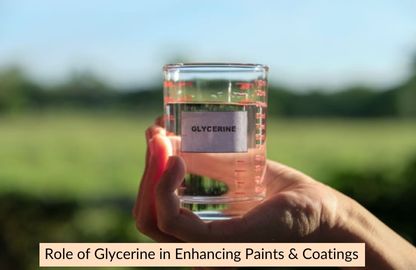
In the evolving landscape of industrial chemistry, glycerine - especially in its refined form like glycerine 99.7% - plays a critical role across a wide range of applications. One such important but often overlooked sector is paints and coatings. Known for its humectant, plasticizing and stabilizing properties, glycerine adds functional benefits that improve both performance and durability in coating systems.
Whether it’s crude glycerine sourced as a by-product of biodiesel or high-purity grades offered by glycerine manufacturers, this compound continues to find essential applications in formulations intended for long-lasting, aesthetically superior finishes. This article explores how glycerine contributes to the paints and coatings industry and what technical advantages it offers.
What Is Glycerine and Why Is It Relevant to Paints and Coatings?
Glycerine, also known as glycerol, is a simple polyol compound with three hydroxyl groups. It’s colorless, odorless and highly viscous. Derived from both vegetable and animal fats during saponification or transesterification, glycerine is widely available from glycerine suppliers in various grades, including technical, refined and crude.
In paints and coatings, glycerine is not just a filler. It acts as a functional additive, offering multiple benefits such as:
- Enhancing viscosity control
- Improving film formation
- Reducing cracking and brittleness
- Supporting pigment dispersion
Its role may vary depending on whether it's used in water-based or solvent-based systems, but its multifunctionality makes it a versatile component in many formulations.
How Does Glycerine Improve Paint Flow and Application Consistency?
One of the key advantages of using glycerine in paint formulations is its ability to act as a flow modifier. Its high viscosity and hygroscopic nature help maintain a consistent paint texture across varying environmental conditions.
Technical Benefits:
- Glycerine 99.7 slows down the evaporation rate of water in waterborne paints, allowing for smoother application and fewer brush marks.
- In spray coatings, it enhances leveling properties, reducing the chances of streaks and uneven coverage.
- When blended correctly, glycerine supports shear-thinning behavior, which improves application without sacrificing stability during storage.
By enabling smoother, more uniform paint application, glycerine contributes to better surface finishes and minimizes rework or waste during production.

In What Ways Does Glycerine Enhance Paint Durability?
Durability is a key performance metric for any coating system, especially in industrial and exterior applications. Glycerine contributes to this in multiple ways:
- Film Flexibility: Glycerine acts as a plasticizer, reducing brittleness and improving the flexibility of dried films. This helps prevent cracking over time due to temperature or mechanical stress.
- Moisture Retention: In waterborne systems, glycerine slows water evaporation, which supports proper film coalescence and stronger film integrity.
- Adhesion Boost: By improving the wetting properties of the formulation, glycerine may enhance adhesion to various substrates, reducing delamination or peeling.
These effects are especially valuable in formulations used for protective coatings in metal structures, building exteriors or flooring systems, where longevity and surface integrity are critical.
Can Glycerine Act as a Stabilizer in Paint Formulations?
Yes, glycerine has a significant role in stabilizing emulsions and dispersions within paint formulations.
- It assists in keeping pigments and binders evenly distributed, preventing sedimentation.
- Glycerine E422 improves the stability of emulsifiers, especially in systems that need long shelf life or are exposed to wide temperature variations.
- In latex-based paints, glycerine supports the emulsification of the polymer dispersions, which is key for maintaining consistency and preventing phase separation.
This stabilizing effect ensures that the product remains homogeneous during storage and easy to remix without specialized equipment, making it highly practical for both industrial and commercial use.
How Do Paint Manufacturers Utilize Crude Glycerine?
While refined glycerine 99.7% is typically used for formulations that require clarity, color control or high purity, crude glycerine still has its place - especially in lower-cost, industrial-grade coatings.
- Crude glycerine, which may contain impurities like water, salts and methanol, can be used in undercoats, primers or construction paints where aesthetic appearance is secondary.
- Its cost advantage and availability from crude glycerine suppliers make it suitable for use in developing markets or for temporary protective coatings.
However, formulations with crude glycerine require careful quality control to manage potential compatibility or odor issues, depending on the end-use.
What Makes Glycerine a Preferred Humectant in Paints and Coatings?
Glycerine’s natural ability to attract and retain moisture makes it an effective humectant in paint systems:
- In interior wall paints, it helps prevent premature drying, allowing for longer working times.
- It ensures color uniformity by keeping the surface moist during drying, reducing patchiness.
- For water-based sealants and fillers, glycerine contributes to workability and prevents cracking upon curing.
This property is especially helpful in fast-drying environments or when paint is applied under less-than-ideal conditions, such as high heat or low humidity.

How Is Glycerine Incorporated into Paint Formulations?
Formulators typically introduce glycerine during the grinding phase or pre-mix phase of paint manufacturing:
- It may be added alongside surfactants and dispersants to improve wetting of pigments.
- In water-based systems, glycerine can be pre-diluted and added gradually to avoid viscosity spikes.
- It must be balanced with other solvents and coalescing agents to prevent over-softening of the final film.
Because glycerine is compatible with most acrylic, latex and vinyl polymer systems, it integrates smoothly into a wide range of architectural and industrial coatings.
Conclusion
Glycerine - whether in its high-purity form or as crude glycerine - plays a critical functional role in modern paint and coating technologies. From acting as a flow enhancer and film plasticizer to improving stability and moisture retention, this multi-functional compound supports better application, enhanced durability and longer shelf life.
By understanding how different grades of glycerine integrate into specific formulations, manufacturers can develop more efficient, reliable and user-friendly paint products suited for a variety of industrial and commercial needs.