

Objective:
This article provides a comprehensive technical and chemical insight into Myristic Acid, focusing on its production, properties, applications and significance in various industries. It explores the chemical structure, production methods, quality control and diverse uses of Myristic Acid, along with its role in personal care, soap formulations, lubricants and other industrial applications.

Myristic Acid: Composition, Properties and Industrial Significance
Myristic Acid, also known as C14 fatty acid, is a saturated fatty acid primarily derived from natural oils such as palm kernel oil and coconut oil. It is widely used in the production of various industrial and consumer goods due to its chemical properties, such as emulsifying, surfactant and foaming abilities. Myristic Acid is a key ingredient in numerous applications across industries, from personal care products to industrial chemicals.
Chemically, Myristic Acid consists of a 14-carbon chain with a carboxyl group at one end. This simple yet effective structure gives it excellent solubility in both water and oil, making it an ideal component in formulations requiring emulsification or stability. Its versatility and performance in various applications make it a valuable raw material for manufacturers.
The industrial significance of Myristic Acid lies in its ability to enhance product quality and performance, making it a crucial ingredient in formulations that require emulsification, surfactant action or controlled stability.
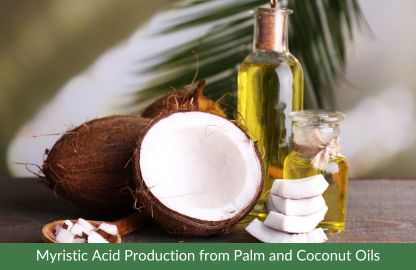
Production of Myristic Acid from Palm Kernel Oil and Coconut Oil
The primary feedstocks for Myristic Acid production are Palm Kernel Oil and Coconut Oil, both of which are rich in lauric acid and Myristic Fatty Acid. These oils undergo fractionation and distillation processes to separate the desired fatty acids, including Myristic Acid.
In the production process, the oils are first refined to remove impurities, followed by fractional distillation to isolate Myristic Acid C14 from other fatty acids. Palm kernel oil and coconut oil are particularly suited for Myristic Acid production due to their high content of lauric and Myristic Fatty Acid, which makes the extraction process more efficient. The extracted Myristic Acid is then purified to meet industrial standards, making it suitable for various applications.
Chemical Structure and Characteristics of Myristic Acid C14 Fatty Acid
The chemical structure of Myristic Acid (C14) consists of a 14-carbon chain with a carboxyl group at one end, which is typical of saturated fatty acids. This structure gives Myristic Acid its solid state at room temperature and contributes to its surfactant and emulsifying properties.
Myristic Acid C14 has a relatively low melting point, which makes it useful in formulations that require smooth texture and stability at varying temperatures. Additionally, its long carbon chain and non-polar nature allow it to interact effectively with both hydrophilic and hydrophobic substances, enhancing its versatility in industrial applications.
Due to its well-defined chemical characteristics, myristic acid is a reliable component in a wide range of products, including soaps, detergents and personal care formulations.
Differences Between Myristic Acid, Lauric Acid and Palmitic Acid
While Myristic Acid, Lauric Acid and Palmitic Acid are all saturated fatty acids, they differ in their chain lengths and applications. Myristic Acid C14 has a 14-carbon chain, Lauric Acid has a 12-carbon chain and Palmitic Acid has a 16-carbon chain. These differences significantly influence their physical properties and their uses in various industrial applications.
Myristic Acid is more versatile than Lauric Acid due to its slightly longer carbon chain, which contributes to its ability to form stable emulsions and foams. Lauric Acid, on the other hand, is more commonly used in the production of soaps and surfactants, while Palmitic Acid is more widely used in food processing, cosmetics and as a stabilizer in various chemical formulations.
Understanding the differences between these fatty acids is essential for selecting the appropriate ingredient for specific formulations, whether for soaps, personal care products or industrial chemicals.
Process Overview: Fractionation and Distillation Techniques for Myristic Acid Extraction
The extraction of Myristic Acid from palm kernel oil and coconut oil typically involves fractionation and distillation. Fractionation separates different fatty acids based on their melting points, allowing the isolation of Myristic Acid C14. Distillation is then used to purify the fatty acid, separating it from other compounds.
Fractionation involves heating the oil to specific temperatures, where the solid fatty acids crystallize and are separated from the liquid fraction. Distillation further refines the fatty acids by separating them based on their boiling points, ensuring that only Myristic Fatty Acid remains in the final product.
These processes ensure the purity and quality of Myristic Acid, making it suitable for various high-performance applications, from personal care products to industrial chemicals.
Understanding Purity Levels and Specifications in Myristic Acid Production
Purity is a crucial factor in Myristic Acid production, as it directly impacts the quality and performance of the final product. In industrial applications, Myristic Acid typically needs to meet specific purity standards, which are determined by the percentage of Myristic Fatty Acid in the product.
High-quality Myristic Acid should contain minimal amounts of other fatty acids, such as Lauric Acid or Palmitic Acid, which could affect the performance of the product. Purity levels are verified through various testing methods, including gas chromatography, which separates the fatty acids based on their chemical properties. Manufacturers must ensure that their Myristic Acid meets these purity specifications to ensure optimal functionality in end products.
Myristic Acid Derivatives: Esters, Soaps and Surfactants Explained
Myristic Acid is used as a base for various derivatives, including esters, soaps and surfactants. Myristic Acid esters are created by reacting the acid with alcohols, resulting in compounds that are used as emollients, solvents and emulsifiers in personal care products.
In soap production, Myristic Acid contributes to the hardness and foaming properties of the soap. It is used in combination with other fatty acids to create balanced formulations that provide a rich lather and a smooth texture. Myristic Acid-based surfactants are also widely used in detergents, cleaners and other formulations requiring effective cleaning agents.
These derivatives of Myristic Fatty Acid are key ingredients in a wide range of consumer goods, highlighting the versatility of Myristic Acid in the chemical industry.
Key Parameters for Quality Control in Myristic Acid Manufacturing
Quality control is essential in Myristic Acid manufacturing to ensure that the final product meets industry standards and performs as expected. Key parameters for quality control include:
- Fatty Acid Composition: The percentage of Myristic Fatty Acid in the product must meet specific standards to ensure the product's functionality.
- Purity: Impurities such as other fatty acids or contaminants must be kept to a minimum to ensure high-performance Myristic Acid.
- Acid Value: This value indicates the level of free fatty acids in the product, with lower values indicating higher purity.
Adhering to these quality control standards ensures that Myristic Acid remains a reliable ingredient in various industrial and consumer applications.
Myristic Acid in Soap and Detergent Formulation: Enhancing Foam and Texture
Myristic Acid plays a significant role in soap and detergent formulations by enhancing foam quality and texture. When used in soap, Myristic Acid contributes to the soap's ability to generate a rich lather, providing consumers with a more luxurious and effective cleaning experience.
In detergents, Myristic Acid-based surfactants improve cleaning power by lowering the surface tension of water, allowing the detergent to penetrate dirt and grease more effectively. Its ability to create stable, long-lasting foam also makes it ideal for use in products where performance and user experience are paramount.
Role of Myristic Acid in Cosmetic and Personal Care Products
Myristic Acid is widely used in the cosmetic and personal care industry due to its emulsifying and emulsifier-stabilizing properties. It helps in the formation of stable emulsions in creams, lotions and other skincare products, ensuring that water and oil-based ingredients mix evenly.
In addition to emulsifying, Myristic Acid also contributes to the texture and feel of personal care products. It provides smoothness and enhances the spreadability of lotions, creams and deodorants, making it a key ingredient in the formulation of high-quality cosmetics.
Application of Myristic Acid in Lubricants, Greases and Metalworking Fluids
Myristic Acid's lubricating properties make it an essential component in the formulation of greases, lubricants and metalworking fluids. Its long carbon chain provides a stable and effective lubricant, reducing friction and wear in industrial machinery. This makes Myristic Fatty Acid a critical ingredient in ensuring the smooth operation of mechanical systems in industries like automotive, aerospace and manufacturing.
Myristic Acid in Candle Manufacturing: Performance and Melting Characteristics
Myristic Acid also plays a role in candle manufacturing, where it is used to modify the melting characteristics of the wax. Its solid form at room temperature helps produce candles with a stable structure, ensuring they burn evenly and efficiently. Myristic Acid's low melting point also contributes to candles' smooth texture and aesthetic appeal, making it a preferred ingredient in premium candle formulations.
Industrial Use of Myristic Acid in Plasticizers and Coating Agents
In the chemical industry, myristic acid C14 is used in the production of plasticizers and coating agents. Myristic Acid-based esters are employed to improve the flexibility and durability of plastics, making them suitable for use in a variety of applications, including packaging, automotive parts and consumer goods.
Additionally, Myristic Acid is used in coating formulations to enhance surface properties such as water resistance, texture and longevity.
How Myristic Acid Improves Emulsion Stability in Creams and Lotions
In cosmetic formulations, Myristic Acid improves the stability of emulsions, helping to create products that are smooth, stable and long-lasting. Its ability to stabilize the oil-water interface makes it a valuable ingredient in creams and lotions, ensuring that the product maintains its consistency and texture throughout its shelf life.
Role of Myristic Acid in Fragrance Fixatives and Perfume Bases
Myristic Acid is often used in perfume formulations as a fragrance fixative. It helps in extending the scent's longevity by slowing down the evaporation rate of volatile aromatic compounds. This allows perfumes and fragrances to maintain their scent for longer periods, enhancing the overall user experience.

Myristic Acid in Food-Grade Additives and Flavor Enhancers
Myristic Acid also finds applications in the food industry, where it is used as a food-grade additive and flavor enhancer. Its ability to interact with fats and oils makes it effective in improving the texture, stability and flavor profiles of various food products.
Conclusion:
Myristic Acid is a versatile and valuable compound with a wide range of applications across multiple industries. From personal care to industrial formulations, its chemical properties make it an indispensable ingredient in numerous products. As demand for bio-based solutions grows, the role of Myristic Acid in various sectors, such as cosmetics, food additives and lubricants, will continue to expand, offering businesses new opportunities for innovation and growth.