

Asia's industrial and consumer sectors are growing at a pace that few commodity markets can ignore — and palmitic acid is no exception. As one of the most widely traded saturated fatty acids in global commerce, palmitic acid export flows into Asian markets have been reshaping in 2026, driven by surging downstream demand, evolving supply chain dynamics, and the region's expanding manufacturing base across cosmetics, food processing, pharmaceuticals, and industrial chemicals. For any palmitic acid supplier, palmitic acid manufacturer, or bulk buyer tracking this space, understanding these export trends is essential to staying competitive.
Understanding Palmitic Acid: A Quick Foundation
Before diving into trade flows, it helps to ground the discussion in what this compound actually is. Palmitic acid — with the palmitic acid chemical formula C16H32O2 — is a 16-carbon saturated fatty acid and one of the most abundant naturally occurring fatty acids on Earth. It is found in palm oil, palm kernel oil, animal fats, and dairy products, with palm oil-derived palmitic acid dominating global commercial production.
Palmitic acid uses span an enormous range of applications. In cosmetics and personal care, it functions as an emollient, emulsifier, and texture enhancer. In food manufacturing, it acts as a processing aid and ingredient in bakery fats and confectionery. In pharmaceuticals, it serves as an excipient and coating agent. Industrially, it finds application in lubricants, surfactants, candles, and rubber processing. This diversity of end-use is precisely why palmitic acid bulk supply flows are so significant — demand is never concentrated in a single sector, making the market structurally resilient even when individual industries slow down.

The Global Export Landscape: Who Supplies Asia?
The dominant global producers of palmitic acid are Malaysia and Indonesia, both of which sit atop the world's palm oil supply chain. Together, these two countries account for the vast majority of global palm oil output — the primary feedstock for commercial palmitic acid extraction — and consequently host the largest concentration of palmitic acid manufacturer facilities in the world.
From these production hubs, palmitic acid moves in bulk to importing nations across Asia, Europe, and the Americas. In 2026, however, intra-Asian trade flows have taken on growing significance. Countries like China, India, South Korea, Japan, Vietnam, and Bangladesh are all major importers — and their demand profiles are evolving in ways that are directly shaping export volumes, product grades, and pricing structures.
The palmitic acid price quoted by Malaysian and Indonesian exporters remains the global reference benchmark, and fluctuations in palm oil futures on the Bursa Malaysia Derivatives Exchange directly translate into movement in palmitic acid export pricing.
Read Our Article
Palmitic Acid: From Soap to Animal Feed – A Multi-Purpose IngredientChina: The Dominant Import Market
China remains the single largest Asian importer of palmitic acid in 2026, absorbing substantial volumes for use across its cosmetics manufacturing sector, food industry, and oleochemical processing base. Chinese demand for palmitic acid in cosmetics has grown particularly strongly, driven by the country's booming domestic personal care market — one of the fastest-growing in the world.
Chinese cosmetics manufacturers use palmitic acid extensively in formulations for skin creams, lotions, lipsticks, foundations, and hair care products, where its emollient and film-forming properties are highly valued. As domestic Chinese brands continue to scale and compete with international players, their raw material procurement volumes have increased substantially — making China an increasingly important destination for any palmitic acid supplier with export capacity.
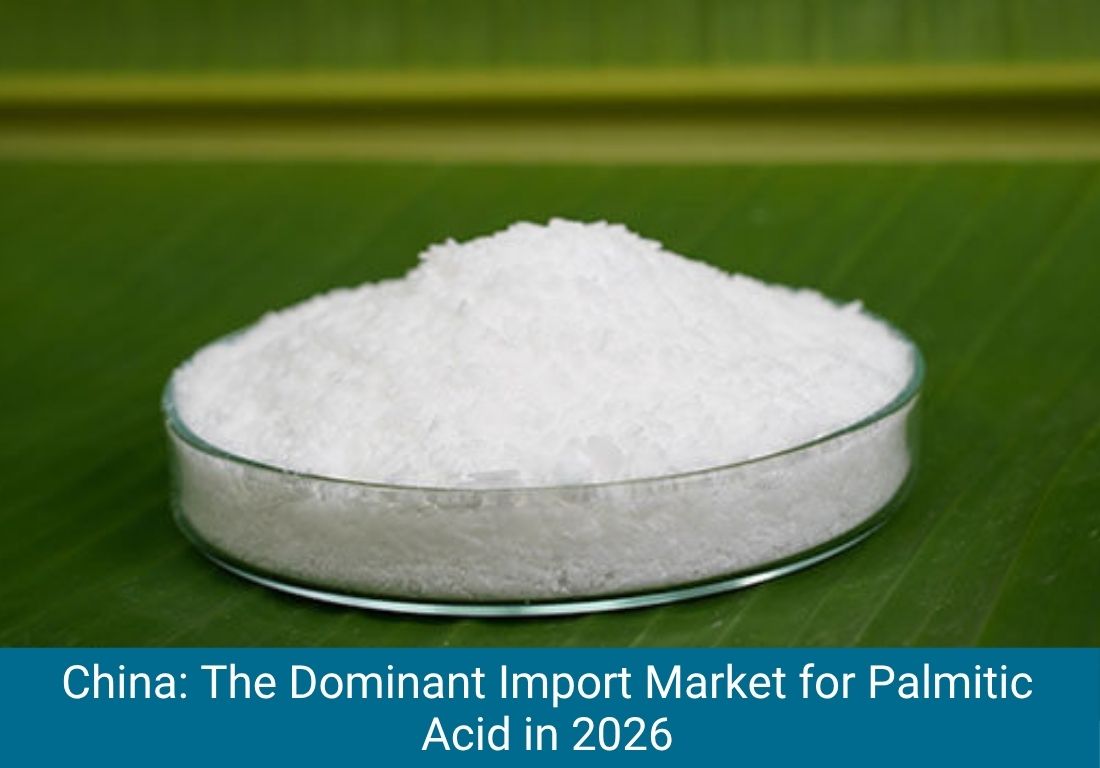
Beyond cosmetics, China's pharmaceutical sector has expanded its use of palmitic acid as a lipid excipient in drug delivery systems, and its food industry continues to consume it as a processing aid. The combined pull from these sectors has kept Chinese import volumes elevated throughout the first half of 2026, with no significant demand softening anticipated in the near term.
India: A Rapidly Growing Import Destination
India represents one of the most dynamic growth stories in the Asian palmitic acid import market. As India's personal care, pharmaceutical, and food processing industries continue to scale, demand for high-quality fatty acid inputs has grown consistently year on year.
Palmitic acid in cosmetics is a major driver of Indian import demand, with the country's rapidly expanding domestic beauty and personal care market requiring reliable palmitic acid bulk supply to feed both large manufacturers and the growing number of mid-sized formulation businesses entering the market. India's pharmaceutical industry — the world's largest generic drug producer — also consumes palmitic acid as an excipient and in lipid-based formulations, adding a significant and stable demand layer.
Indian buyers are particularly price-sensitive, making palmitic acid price competitiveness a primary factor in supplier selection. Malaysian and Indonesian exporters have maintained strong positions in the Indian market due to geographic proximity and established trade relationships, though Indian buyers are increasingly diversifying their palmitic acid supplier base to include domestic manufacturers who can offer faster lead times and reduce currency exposure.
Southeast Asia: Intra-Regional Trade Dynamics
An interesting feature of 2026's export landscape is the growing significance of intra-Southeast Asian trade in palmitic acid. Countries like Vietnam, Thailand, and the Philippines — which host large and growing personal care manufacturing sectors — are importing increasing volumes from Malaysian and Indonesian producers.
Vietnam in particular has emerged as a notable importer, as its cosmetics and personal care manufacturing base has grown substantially on the back of foreign investment and rising domestic consumption. Thai food and pharmaceutical manufacturers similarly represent a consistent demand base for palmitic acid bulk supply within the region.
This intra-regional trade growth is partly a product of ASEAN's relatively low tariff environment for oleochemical products, which facilitates efficient cross-border trade between producing and consuming nations within the bloc.
Our Other Products
Soap NoodlesJapan and South Korea: Premium Grade Demand
Japan and South Korea occupy a distinct position in the Asian palmitic acid import market — they are relatively smaller in volume compared to China and India, but they consistently demand the highest product grades and the most rigorous quality certifications. For any palmitic acid manufacturer targeting these markets, the bar for purity, batch consistency, and documentation is significantly higher than for commodity-grade export destinations.
Both markets are driven primarily by their world-class cosmetics industries. Japan's cosmetics sector — home to global brands and highly sophisticated formulation standards — uses palmitic acid C16 as a key ingredient in premium skincare and makeup formulations. South Korea's K-beauty industry, which has achieved remarkable global reach, similarly relies on high-purity fatty acid inputs for the innovative formulations that have become its trademark.
For exporters, securing supply relationships with Japanese and Korean buyers requires investment in quality systems and certifications, but delivers premium pricing and long-term contractual stability — a worthwhile trade-off for producers with the capability to meet these standards.
Palmitic Acid Price Dynamics Affecting Asian Export Flows
Palmitic acid price in 2026 has been shaped by several converging forces that both buyers and exporters must navigate carefully.
Palm Oil Feedstock Costs: Since palmitic acid is predominantly derived from palm oil, movements in crude palm oil (CPO) prices remain the primary determinant of export pricing. In 2026, palm oil production in Malaysia has faced headwinds from labour shortages and higher fertiliser costs, maintaining CPO prices at elevated levels relative to historical averages and providing a floor under palmitic acid export pricing.
Export Taxes and Policies: Both Malaysia and Indonesia have historically used export levies on palm oil and derivatives to manage domestic supply and generate revenue. Any adjustment to these levy structures directly impacts the competitiveness of palmitic acid bulk supply from these origins and can shift trade flows toward or away from specific export destinations.
Energy and Production Costs: Rising energy costs at oleochemical refining facilities in Malaysia and Indonesia have added to the cost base for palmitic acid manufacturer operations, contributing to a gradual upward drift in base pricing that has been felt across all Asian import markets.
Currency Movements: The USD/MYR and USD/IDR exchange rates play a meaningful role in determining how palmitic acid price translates for buyers paying in local currencies. In markets like India and Vietnam, local currency depreciation against the USD can amplify the cost impact of any global price increase.
Read Our Article
Palmitic Acid Process Optimization & Quality ControlWhat Buyers Should Know When Sourcing in 2026
For procurement professionals and formulation buyers across Asia, several practical considerations are worth keeping in mind when engaging with palmitic acid suppliers and exporters in 2026.
Grade Specification Matters: Palmitic acid is available in multiple grades — cosmetic, food, pharmaceutical, and technical/industrial. Clearly specifying your required grade at the outset of any supplier conversation avoids misalignment and ensures you receive appropriate pricing and documentation.
Bulk vs. Packaged Supply: For high-volume industrial or manufacturing buyers, palmitic acid bulk supply in flexi-tanks or ISO containers from established palmitic acid manufacturer facilities delivers the best per-unit economics. Smaller buyers or those requiring specific grades may find packaged supply more practical despite the cost premium.
Lead Time Planning: With shipping routes and port congestion remaining unpredictable in 2026, building adequate lead time into procurement planning — particularly for buyers in landlocked or port-constrained markets — is essential to avoiding supply gaps.

Outlook: Asian Demand Will Continue to Drive Export Growth
The trajectory for palmitic acid exports into Asian markets remains firmly positive through the remainder of 2026 and into the medium term. China's cosmetics and pharmaceutical industries show no sign of demand softening. India's manufacturing sectors continue to scale. Southeast Asian personal care manufacturing is expanding. And premium markets like Japan and South Korea maintain steady demand for the highest quality grades.
For palmitic acid manufacturers and exporters positioned to serve these markets reliably — with competitive palmitic acid price structures, certified sourcing, and consistent product quality — Asia represents the most dynamic and rewarding export destination in the global fatty acid trade.
The businesses that invest now in supply chain resilience, quality certification, and strong buyer relationships across these markets will be the ones best placed to capture the growth that 2026 and beyond has to offer.