

RBD Coconut Oil: The Industrial Grade That Drives Soap, Oleochemicals, and Food Manufacturing Globally
RBD Coconut Oil is the backbone of industrial coconut oil use worldwide. Unlike the retail-positioned virgin coconut oil that dominates consumer health channels, RBD Coconut Oil is the refined, bleached, and deodorised form produced from dried copra through an industrial refining process, delivering a neutral, colourless, food and oleochemical grade oil at competitive bulk prices. Its unique fatty acid profile, dominated by lauric acid at 45 to 53 percent, makes it the primary lathering agent contributor in soap manufacturing, a critical feedstock for CFAD and DCFA in oleochemical production, and a valuable fat component in food and personal care formulations. This article covers the production process, fatty acid composition, food and industrial applications, and the quality documentation that bulk buyers should verify when sourcing RBD Coconut Oil for export.
Read Our Article
RBD Coconut Oil: An Essential Ingredient in Natural Home RemediesWhat Is RBD Coconut Oil and What Does RBD Mean?
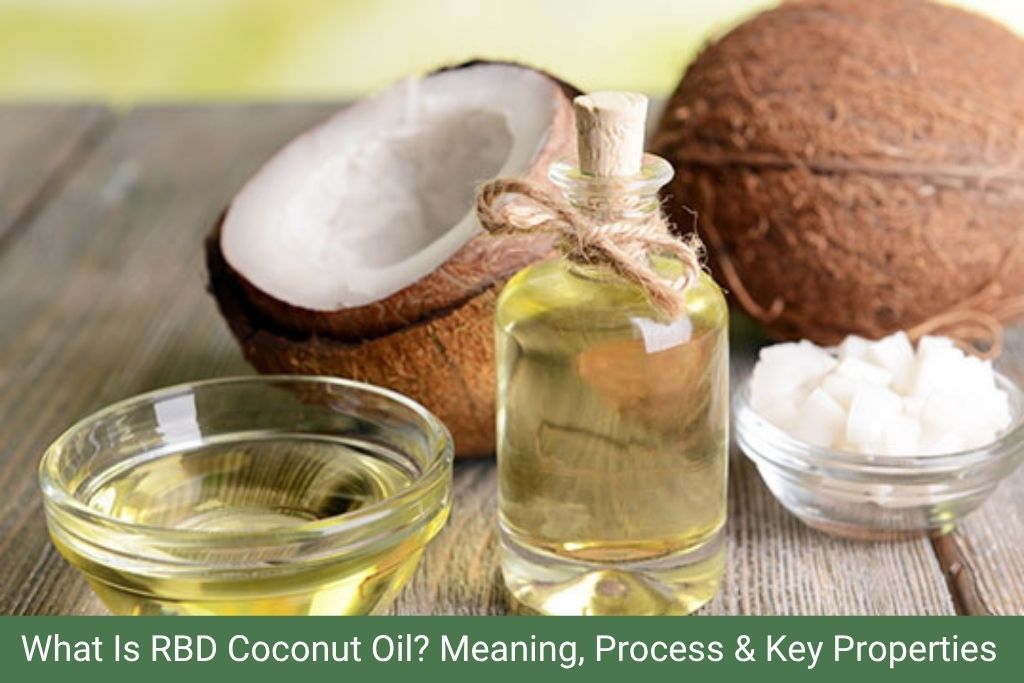
RBD Coconut Oil stands for Refined, Bleached, and Deodorised Coconut Oil. It is produced from Crude Coconut Oil - also called copra oil - through a sequence of industrial refining processes that remove free fatty acids, colour pigments, and volatile odour compounds. The refining step (physical or chemical) reduces the Free Fatty Acid content from the crude level of 3 to 5 percent down to below 0.1 percent. Bleaching with activated earth removes colour bodies and trace metals. Deodorisation using steam under high temperature and vacuum removes the volatile compounds that give crude coconut oil its characteristic aroma, producing an oil that is colourless, odourless, and functionally neutral. What is RBD coconut oil in practical terms: it is the standard industrial and food-grade form of coconut oil used in soap manufacturing, personal care, food production, and oleochemical processing, as opposed to virgin coconut oil which is cold-pressed from fresh coconut meat without chemical refining.
Our Other Products
Fatty Alcohol - Cetyl-Stearyl Alcohol, Lauryl-Myristyl AlcoholHow Does RBD Coconut Oil Differ from Virgin Coconut Oil?
RBD Coconut Oil and virgin coconut oil (VCO) come from the same source - the coconut - but they are fundamentally different products with entirely different applications and commercial positioning. VCO is cold-pressed or expeller-pressed from fresh coconut meat (not dried copra), producing an oil that retains its natural aroma, flavour, and the polyphenol compounds that are removed during refining. VCO commands a premium price in the retail health food and personal care markets. RBD Coconut Oil is produced from dried copra through an industrial extraction and refining process, producing a neutral-tasting, colourless oil at a significantly lower cost per tonne. For industrial users - soap manufacturers, oleochemical processors, food manufacturers, and personal care companies - RBD Coconut Oil is the appropriate specification because the aroma neutrality, consistent fatty acid profile, and low FFA are required for the intended application. The choice between VCO and RBD Coconut Oil is driven entirely by the end use: VCO for premium retail consumer products, RBD Coconut Oil for industrial and bulk food manufacturing.

What Is the Fatty Acid Composition of RBD Coconut Oil and Why Does It Matter?
RBD Coconut Oil has a unique fatty acid profile among commercially important vegetable oils: approximately 90 percent of its fatty acid content is saturated, with the dominant components being lauric acid (C12:0) at 45 to 53 percent, myristic acid (C14:0) at 16 to 21 percent, caprylic acid (C8:0) at 5 to 9 percent, capric acid (C10:0) at 4 to 8 percent, and palmitic acid (C16:0) at 7 to 10 percent. This high lauric acid content is why coconut oil rbd is so widely used in soap manufacturing: sodium laurate, the saponification product of lauric acid, is the primary lathering agent in soap bars, producing abundant foam even in hard water. The medium-chain fatty acid profile (C8, C10, C12) also makes RBD Coconut Oil valuable as a feedstock for splitting and distillation to produce distilled coconut fatty acids (DCFA and CFAD), caprylic/capric acid fractions for pharmaceutical and food applications, and lauric acid for personal care and surfactant manufacturing.
What Are the Industrial and Food Applications of RBD Coconut Oil?
RBD Coconut Oil is one of the most versatile fats in global oleochemical and food manufacturing. In soap production, it is used either directly in saponification to produce soap noodles with high lather performance, or as a blending component alongside palm oil to balance bar hardness (from palm) with lathering ability (from coconut). In food manufacturing, RBD Coconut Oil is used as a frying medium in snack food production, as a fat component in confectionery fillings and coatings, as a dairy fat replacement in vegetable-based beverages and desserts, and in specialty fat formulations where its high saturated content provides stability and texture. In personal care, RBD Coconut Oil is used as an emollient base in skin creams, hair conditioners, and massage oils where its lauric acid content provides moisturising and antimicrobial properties. In oleochemical production, it is the primary feedstock for CFAD, DCFA, lauric acid, and caprylic/capric acid triglycerides. Crude Coconut Oil Suppliers typically supply to refiners who then produce RBD Coconut Oil for the downstream market.
What Should Bulk Buyers Verify When Sourcing RBD Coconut Oil for Export?
Buyers sourcing RBD Coconut Oil in bulk from a RBD Coconut Oil Supplier or RBD Coconut Oil Exporter should request and verify the following documentation and specifications before confirming an order. The Certificate of Analysis must show: Free Fatty Acid content below 0.1 percent as lauric acid, Iodine Value in the range of 6.3 to 10.6, Saponification Value in the range of 248 to 265, Moisture and Volatile Matter below 0.1 percent, Peroxide Value below 2 milliequivalents per kilogram, colour as water white on the Lovibond scale, and absence of adulterants including palm oil and other vegetable oils on a fatty acid profile test. For food-grade applications, Halal certification, Kosher certification where required, and RSPO documentation should also be requested. Olivia Oleo exports RBD Coconut Oil with full documentation from Singapore and can provide samples, advance technical data sheets, and third-party test reports to support buyer qualification processes.

RBD Coconut Oil Sourcing: Quality, Documentation, and Supply Chain Fundamentals for Bulk Buyers
RBD Coconut Oil is an essential industrial fat for soap manufacturers, oleochemical producers, food manufacturers, and personal care companies globally, and its quality consistency is determined by the rigour of the refining process and the integrity of the Certificate of Analysis provided by the supplier. Buyers sourcing RBD Coconut Oil for export should verify FFA content, Iodine Value, Saponification Value, moisture, peroxide value, and colour alongside Halal, Kosher, and RSPO documentation as required by their application and destination market. Olivia Oleo exports RBD Coconut Oil with the full documentation package that international industrial buyers require, backed by advance technical data sheets, third-party test report availability, and the ability to provide samples before bulk order commitment. Contact our team to discuss your RBD Coconut Oil specification and volume requirement.