

Soap noodles are the foundational raw material for nearly all bar soaps, serving as the pre-processed base to which manufacturers add color, fragrance, and specialized ingredients. The quality of the final soap product—its lather, texture, durability, and safety—is entirely dependent on the quality of these noodles. Consequently, stringent inspection and laboratory testing procedures are non-negotiable for manufacturers aiming for consistency and consumer satisfaction.

Laboratory Testing Methods to Assess Soap Noodle Purity
Assessing the purity of soap noodles is critical, as it determines their suitability for different applications (e.g., high-grade toilet soap vs. laundry soap). Standard testing is governed by international bodies like the American Oil Chemists' Society (AOCS) and local regulatory standards.
| Test Parameter | Test Method / Significance |
|---|---|
| Total Fatty Matter (TFM) | The most crucial quality indicator. TFM is the total amount of fatty matter (fatty acids and unsaponifiable matter) in the soap, expressed as a percentage. It is typically determined by solvent extraction followed by gravimetric analysis. A higher TFM (e.g., 78–80%) signifies a higher-quality, more moisturizing soap base. |
| Moisture Content (M.C.) | Measures the water and volatile matter. Typically determined by oven drying (loss in weight) or Karl Fischer titration. Excess moisture reduces shelf life, causes premature disintegration, and affects hardness. Optimal levels are usually between 8% and 14%. |
| Total Free Alkali / Caustic Soda (NaOH) | Measures any unreacted alkali remaining after saponification. Determined by titrimetric determination (acid-base titration). A high free alkali content makes the final soap harsh, irritating to the skin, and unsafe for consumer use. Must be kept below a very low limit (e.g., <0.05%). |
| Insoluble Matter | Measures residual dirt, unsaponified fat, or inorganic salts. Determined by treating the sample with a solvent and weighing the remaining residue. High levels degrade the soap's aesthetic quality and cleaning performance. |
| Free Fatty Acid (FFA) | Measures the presence of any un-neutralized fatty acids. High FFA indicates an incomplete reaction or potential breakdown, affecting stability and odor. |
| Glycerin Content | Glycerin is a moisturizing by-product. Measured through chemical analysis (often using chromatography or specific enzymatic tests) to ensure the noodles retain enough of this valuable agent for moisturizing properties. |
Read Our Article: Your Guide to White, Multipurpose, and Laundry Soap Noodles
Sensory Evaluation Techniques for Soap Noodles
While laboratory tests provide objective chemical data, sensory evaluation offers critical subjective data on appearance and handling that affects the final product.
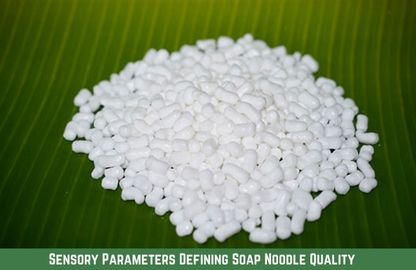
- Visual Inspection: Noodles must be uniform in color (typically white to light cream), size, and shape. Discoloration, off-color spots, or black specks can indicate impurities or oxidation. Snow White Soap Noodles (SWSN) require the most stringent visual purity.
- Texture and Hardness: Noodles should be firm, smooth, and free from cracks or lumps. Extrusion and compression tests can provide quantitative data on plasticity and workability, ensuring they process easily in the downstream soap-making machinery (e.g., plodders).
- Odor Assessment: The basic noodles should have a minimal or neutral odor to allow for the easy addition of final fragrances. Any unpleasant or rancid smell (rancidity) is a sign of oil degradation (oxidation) and indicates poor quality raw materials or improper storage.
Shelf Life Testing Procedures for Soap Noodles
A robust shelf life is vital for soap noodles, especially for Agarwood Manufacturers or other producers who may store the base for months. This testing often involves Accelerated Aging to simulate long-term effects quickly.
- Accelerated Aging Test (AAT) / Highly Accelerated Stress Test (HAST): Samples are stored in controlled chambers under exaggerated conditions—typically higher-than-normal temperatures (e.g., 35°C to 50°C) and/or humidity levels.
- Periodic Analysis: The samples are periodically pulled and tested for critical quality parameters:
- TFM and Moisture Content: To detect any significant change in composition.
- Acid Value: A significant increase in acid value is the primary indicator of rancidity (hydrolytic and oxidative degradation of the fatty acids).
- Color Stability: To ensure the noodles do not yellow or darken over time.
- Microbiological Count: To monitor for any growth of mold or bacteria, especially in high-moisture samples.
Microbiological Safety in Soap Noodles Manufacturing
Although high pH (alkalinity) generally inhibits microbial growth, microbiological safety remains crucial, particularly for cosmetic-grade noodles.
- Contamination Points: Contamination usually stems from raw materials (fats/oils), process water, or poor hygiene in handling and packaging.
- Testing Protocol: Standard tests include Total Viable Count (TVC) or Total Plate Count (TPC) to determine the overall level of bacteria and fungi. Specific tests are also conducted for common pathogens like Staphylococcus aureus and Pseudomonas aeruginosa.
- Control Measures: Strict quality control during processing (e.g., using clean process water and sterile equipment) and ensuring the free alkali content is correct minimizes the risk of microbial survival and proliferation during the manufacturing phase and storage.

How Storage Conditions Affect Soap Noodle Chemical Stability
Improper storage can rapidly degrade the quality of even the best-quality soap noodles through chemical and physical changes.
| Factor | Effect on Chemical Stability | Best Practice for Storage |
|---|---|---|
| Temperature | High temperatures accelerate the oxidation of unsaturated fatty acids, leading to rancidity (off-odor/discoloration) and reduced shelf life. | Store in a cool environment, ideally between 15°C and 25°C. |
| Humidity / Moisture | Soap noodles are hygroscopic and absorb water. High humidity increases moisture content, accelerating hydrolysis and microbial growth, and causing the noodles to clump or soften. | Maintain low humidity (below 60%). Use moisture-proof packaging such as polyethylene or polypropylene bags. |
| Oxygen Exposure | Oxygen exposure promotes oxidative rancidity, where the fatty acids react with air. | Use well-sealed, high-barrier packaging. Avoid prolonged exposure to air during handling and storage. |
| Light | Direct sunlight or UV exposure can speed up the photo-oxidation process, accelerating degradation and discoloration. | Store in a dark warehouse or shaded area, away from direct sunlight. |
By adhering to these rigorous chemical, physical, and environmental standards, soap noodle suppliers can guarantee a stable, high-performance base, ensuring the final soap product meets the safety and quality expectations of the global consumer market.