

Objective:
This article provides an in-depth overview of various Stearic Acid grades and their applications across industries. It covers the specific uses of TPSA 1838, TPSA 1842, SA 1850, SA 1865, SA 1870 and SA 1892 in manufacturing, cosmetics, rubber compounding and plastic production. The article also compares the performance characteristics, purity and cost efficiency of different grades, emphasizing their importance in industrial and consumer product formulations.

TPSA 1838 Stearic Acid: Applications in Cosmetics, Candles and Lubricants
TPSA 1838 Stearic Acid is a highly refined form of Stearic Fatty Acid, recognized for its exceptional purity and consistent performance. This grade of Stearic Acid is primarily used in the cosmetics industry for products like lotions, creams and ointments due to its excellent emollient properties, providing smooth texture and moisture retention. Its high melting point makes it an essential ingredient in candle manufacturing, where it contributes to a firm structure and longer burn time.
TPSA 1838 is also widely used in lubricant formulations, where it acts as a stabilizer and thickening agent, ensuring the lubrication system operates efficiently at high temperatures. The high purity of TPSA 1838, coupled with its ability to improve product stability and consistency, has contributed to its growing global demand in both personal care and industrial applications.
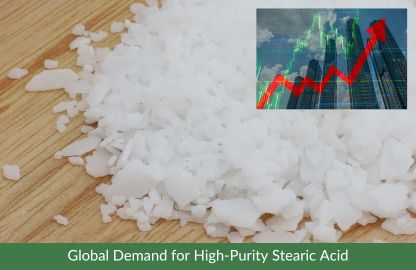
Physical and Chemical Properties of TPSA 1838 and Its Global Demand
TPSA 1838 Stearic Acid is a solid at room temperature with a melting point around 70-72°C and it is highly prized for its low level of impurities. The chemical composition includes long-chain saturated fatty acids that provide excellent stability in various applications. Its high melting point makes it ideal for applications where high thermal stability is necessary, such as in candles and lubricants.
The global demand for TPSA 1838 is driven by its versatility and superior performance in demanding applications. As a major supplier of Stearic Acid, Palm Stearin is the most common feedstock for this high-quality grade. TPSA 1838 is essential for high-end cosmetic products, industrial formulations and certain pharmaceutical products, where purity and performance are critical.
TPSA 1838 vs. TPSA 1842: Which Grade Offers Better Stability for Industrial Use?
When comparing TPSA 1838 and TPSA 1842, the key difference lies in the stability and purity of the product. While both grades of Stearic Acid are highly refined, TPSA 1838 offers slightly better performance in terms of consistency and minimal impurity levels, making it ideal for sensitive applications like cosmetics and pharmaceuticals. TPSA 1842, on the other hand, has a slightly lower level of refinement and is generally preferred for industrial applications where cost-efficiency and adequate stability are the primary considerations.
TPSA 1842 is often used in applications like PVC processing and plastic manufacturing, where its slightly lower price point offers a cost-effective solution without sacrificing much in terms of performance. TPSA 1838 is preferred for applications that require superior stability and purity, while TPSA 1842 finds its place in industrial-grade formulations.
TPSA 1842 Stearic Acid in Plastic and PVC Processing: Key Benefits
TPSA 1842 Stearic Acid is widely used in plastic and PVC processing due to its excellent lubricating properties. In PVC manufacturing, TPSA 1842 acts as a lubricant, reducing friction during extrusion and molding processes. This helps to improve the surface finish and ease of processing, ensuring a smoother and more efficient production process.
In addition, TPSA 1842 contributes to the thermal stability of PVC products by preventing degradation at higher temperatures, thereby improving the quality and longevity of plastic products. It is also commonly used in masterbatch production, enhancing the processing capabilities and ensuring a consistent product quality in the plastics industry.
How TPSA 1842 Enhances Product Finish in Cosmetic and Personal Care Formulations
In the cosmetics and personal care industries, TPSA 1842 Stearic Acid is valued for its ability to improve the texture and appearance of creams, lotions and other topical formulations. Its emulsifying properties help stabilize formulations, ensuring a smooth, non-greasy finish while enhancing the product’s spreadability on the skin.
The inclusion of TPSA 1842 in cosmetics provides a rich, creamy texture, making it a preferred ingredient in high-end beauty products. It also helps retain moisture on the skin, giving the skin a smooth and hydrated feel. With its cost-effective properties and reliable performance, TPSA 1842 is an excellent choice for personal care applications.
Optimal Usage Ratio of TPSA 1842 in Soap and Candle Manufacturing
In soap and candle manufacturing, TPSA 1842 Stearic Acid is often used at a specific ratio to achieve the desired hardness, texture and stability. Typically, in soap formulations, a ratio of 2-5% of TPSA 1842 is used to improve the texture, lather and moisture-retaining properties of the soap. In candle making, it is used in higher concentrations (up to 20%) to provide structural integrity and a longer burn time.
TPSA 1842 enhances the quality and longevity of candles, helping them burn more consistently without breaking apart. Its stable chemical properties ensure that both soap and candles maintain their form and performance throughout their lifespan.
SA 1850 Stearic Acid: High-Purity Grade for Industrial and Cosmetic Applications
SA 1850 Stearic Acid is a high-purity grade of Stearic Acid used in a wide range of industrial and cosmetic applications. In the cosmetic industry, SA 1850 is used to enhance the texture and stability of creams, lotions and other personal care products. Its ability to act as a moisturizer and emulsifier makes it an essential ingredient for skincare formulations.
In industrial applications, SA 1850 is used as a processing aid in lubricants, release agents and plastic manufacturing. Its high-purity nature ensures a consistent and reliable performance, reducing the presence of impurities that could negatively affect the quality of the final product.
Key Performance Characteristics of SA 1850 in Lubricant and Release Agent Formulations
SA 1850 Stearic Acid is highly valued in lubricant and release agent formulations for its ability to improve the overall performance of industrial products. As a lubricant, it reduces friction and wear between moving parts, leading to increased efficiency and extended equipment life. In release agent formulations, SA 1850 helps prevent sticking, ensuring smooth operation during manufacturing processes like molding and casting.
Its consistent quality and ability to perform at both high and low temperatures make it an ideal choice for industrial-grade lubricants and release agents, providing a cost-effective solution without compromising performance.
SA 1850 vs. SA 1865: Comparison in Processing Performance and Cost Efficiency
When comparing SA 1850 and SA 1865, the main differences lie in processing performance and cost-efficiency. While both grades are used in similar applications, SA 1865 is generally a more cost-effective option for industrial uses that do not require the highest levels of purity. SA 1850, on the other hand, is ideal for applications in cosmetics and high-end industrial formulations, where consistency and performance are critical.
SA 1865 may have slightly lower refining levels, making it a more affordable choice for larger-scale industrial production. However, when purity and high performance are key requirements, such as in cosmetic formulations or high-temperature applications, SA 1850 is often preferred for its superior characteristics.
SA 1865 Stearic Acid: Ideal for Rubber Compounding and Plasticizer Production
SA 1865 Stearic Acid is widely used in rubber compounding and plasticizer production due to its ability to improve the processing and performance of rubber products. In rubber compounding, SA 1865 acts as a dispersing agent, ensuring uniform mixing of additives like accelerators and curing agents, thereby enhancing the overall quality of the rubber.
Additionally, SA 1865 plays a crucial role in the production of plasticizers, which are added to plastics to increase their flexibility and workability. Its ability to modify the properties of rubber and plastics makes it a critical ingredient in the production of durable, high-performance products like tires, hoses and seals.
Role of SA 1865 in Enhancing Tensile Strength and Flexibility in Rubber Products
SA 1865 Stearic Acid contributes to the tensile strength and flexibility of rubber products by improving the dispersion of reinforcing agents like carbon black in the rubber matrix. This ensures that the rubber retains its strength while remaining flexible, which is crucial in applications such as tires and industrial belts.
Its impact on improving the mechanical properties of rubber products makes SA 1865 a key ingredient in the tire manufacturing industry, where flexibility, durability and strength are essential for high-performance products.
Performance Testing of SA 1865 in Tire Manufacturing and Vulcanization
SA 1865 Stearic Acid is extensively tested in tire manufacturing, particularly in the vulcanization process. During vulcanization, the Stearic Acid aids in the dispersion of sulfur and other curing agents, ensuring a consistent and uniform cure. This leads to better tire performance, including improved wear resistance, grip and flexibility.
Performance testing of SA 1865 in tires involves evaluating its impact on the durability, heat resistance and overall longevity of the tire, making it a crucial component in the production of high-quality tires.
SA 1870 Stearic Acid: Versatile Grade for Candle, Cosmetic and PVC Applications
SA 1870 Stearic Acid is a versatile grade of Stearic Acid that finds use in a variety of applications, including candles, cosmetics and PVC processing. In candles, SA 1870 helps improve the hardness and burning characteristics, making it a popular choice for manufacturers looking for cost-effective alternatives to more premium grades.
In cosmetics, it serves as an emulsifier and stabilizer, helping maintain the consistency of creams, lotions and soaps. Its ability to work across a range of applications has made it a popular choice in both industrial and personal care sectors.
Industrial Uses of SA 1870 in Masterbatches and Mould Release Formulations
SA 1870 Stearic Acid is commonly used in masterbatch production and mould release formulations. As a lubricant, it enhances the flow of plastics during processing, reducing friction and improving the finish of the final product. In mould release formulations, SA 1870 ensures smooth and easy removal of molded plastic products, improving production efficiency and reducing defects.
SA 1870 vs. SA 1892: Key Differences in Melting Point and Purity
The primary differences between SA 1870 and SA 1892 lie in their melting points and purity levels. SA 1892 typically has a higher melting point and is more refined, making it better suited for high-temperature industrial applications and products that require better stability under stress. In contrast, SA 1870 is a more cost-effective alternative for general industrial applications.
SA 1892 Stearic Acid: Premium Grade for High-Temperature Industrial Applications
SA 1892 Stearic Acid is a premium grade that is particularly suited for high-temperature industrial applications. Its high melting point and excellent stability make it ideal for use in high-performance formulations, including engineering plastics and thermoplastics. It is also used as a lubricant and stabilizer in polymer processing, ensuring better processing characteristics and stability under extreme conditions.
Benefits of Using SA 1892 in Polymer Processing and Engineering Plastics
SA 1892 offers several benefits when used in polymer processing and engineering plastics, including enhanced lubrication, improved dispersion and better temperature stability. It improves the processing efficiency of high-performance polymers and helps maintain the integrity of plastics under high-stress conditions.
SA 1892 as a Lubricant and Stabilizer in Thermoplastic Manufacturing
In thermoplastic manufacturing, SA 1892 plays a critical role in improving the flow properties of the polymer melt, reducing friction and preventing degradation during processing. Its use as a lubricant and stabilizer enhances the overall performance of thermoplastic materials, making them suitable for a range of high-performance applications in automotive, electronics and other industries.
Rubber Grade Stearic Acid: Importance in Tyre, Tube and Belt Manufacturing
Rubber Grade Stearic Acid is essential in the production of tires, tubes and belts, where it plays a critical role in accelerating the vulcanization process. It aids in the dispersion of curing agents, ensuring that the rubber is properly crosslinked, leading to improved strength, durability and performance.
Role of Rubber Grade Stearic Acid in Accelerating Vulcanization Reactions
Rubber Grade Stearic Acid is used to accelerate the vulcanization reactions, which is the chemical process that cross-links the rubber molecules. This improves the physical properties of rubber, making it more elastic, resistant to wear and suitable for high-performance applications such as tires and seals.
How Rubber Grade Stearic Acid Improves Dispersion and Flexibility in Rubber Compounds
Rubber Grade Stearic Acid improves the dispersion of fillers like carbon black and silica in rubber compounds, ensuring uniformity in the final product. It also enhances the flexibility and tensile strength of rubber, making it essential in applications that require flexibility, such as tire treads and conveyor belts.

Key Quality Parameters of Rubber Grade Stearic Acid for Automotive Applications
Key quality parameters for Rubber Grade Stearic Acid include its purity, melting point and ability to maintain performance under high temperatures. For automotive applications, consistency in these properties ensures that the rubber maintains its performance throughout the product lifecycle.
Comparison Between Rubber Grade and Cosmetic Grade Stearic Acid
The main differences between Rubber Grade and Cosmetic Grade Stearic Acid lie in their refinement levels and intended applications. Rubber Grade Stearic Acid is less refined and focused on improving the physical properties of rubber products, while Cosmetic Grade Stearic Acid is highly refined, ensuring minimal impurities for safe use in skin contact products.
Conclusion
Stearic Acid is a versatile and essential ingredient across various industries, with specific grades suited for diverse applications. From cosmetics and lubricants to rubber compounding and plastic processing, the different grades of Stearic Acid, such as TPSA 1838, SA 1850 and Rubber Grade Stearic Acid, provide tailored solutions for performance, stability and cost-efficiency. Understanding the unique properties and applications of each grade ensures the selection of the right Stearic Acid for optimal results in product development.