Coconut Fatty Acid Distillate (CFAD): The Cost-Effective Lauric Feedstock for Soap, Rubber, and Detergent Manufacturing
Coconut Fatty Acid Distillate is a high-value co-product of coconut oil refining that provides a cost-effective source of lauric acid-rich fatty acids for soap manufacturing, rubber processing, detergent production, and personal care applications. Often compared to its higher-purity counterpart, Distilled Coconut Fatty Acid (DCFA), CFAD occupies the more economical end of the coconut fatty acid product spectrum while still delivering the high Free Fatty Acid content and lauric acid profile that industrial buyers require for efficient saponification and foam generation. Understanding the distinction between CFAD and DCFA, the fatty acid composition that determines their respective suitability for different industrial applications, and the storage and handling requirements that govern their logistics is essential for any procurement team sourcing coconut-derived fatty acid inputs. This article covers all of these dimensions comprehensively.

What Is Coconut Fatty Acid Distillate (CFAD) and How Is It Produced?
Coconut Fatty Acid Distillate (CFAD) is a co-product of the physical refining of crude coconut oil. When crude coconut oil undergoes the deodorisation step of physical refining, fatty acids and other volatile components are stripped from the oil by high-temperature steam under high vacuum. The collected distillate - the Coconut Fatty Acid Distillate - contains a mixture of free fatty acids, primarily derived from the coconut oil's characteristic medium-chain and lauric acid profile, along with minor quantities of sterols, tocopherols, and other volatile compounds. CFAD should be distinguished from Distilled Coconut Fatty Acid (DCFA), which is produced by the fatty acid splitting and steam distillation of coconut oil - a more refined product with higher fatty acid purity and lower impurity content. In commercial supply chains, CFAD is the lower-cost, higher-FFA co-product stream available directly from coconut oil refinery operations, while DCFA is a specifically manufactured product from the oleochemical industry. Both are supplied by Olivia Oleo to industrial buyers requiring coconut-derived fatty acid inputs.
What Is the Fatty Acid Composition of CFAD and Why Does It Matter for Industrial Applications?
The fatty acid composition of Coconut Fatty Acid Distillate closely reflects the fatty acid profile of the parent coconut oil from which it is derived, but with a higher proportion of free fatty acids and a lower proportion of the longer-chain components that remain in the refined oil. Typical CFAD composition includes: lauric acid (C12:0) at 40 to 50 percent, myristic acid (C14:0) at 14 to 19 percent, caprylic acid (C8:0) at 4 to 8 percent, capric acid (C10:0) at 4 to 7 percent, palmitic acid (C16:0) at 6 to 10 percent, and oleic acid (C18:1) at 4 to 8 percent. This coconut fatty acid profile, dominated by the medium-chain lauric acid fraction, is what gives CFAD its value in soap manufacturing, personal care, and detergent applications. The high lauric acid content means that soaps made with coconut fatty acid distillate as a feedstock component produce abundant foam and lather rapidly, even in hard water conditions - a property that palm oil-only soap bases cannot match without a coconut or palm kernel input.
Our Other Products
RBD Palm Oil & Palm Kernel OleinWhat Are the Industrial Applications of Coconut Fatty Acid Distillate?
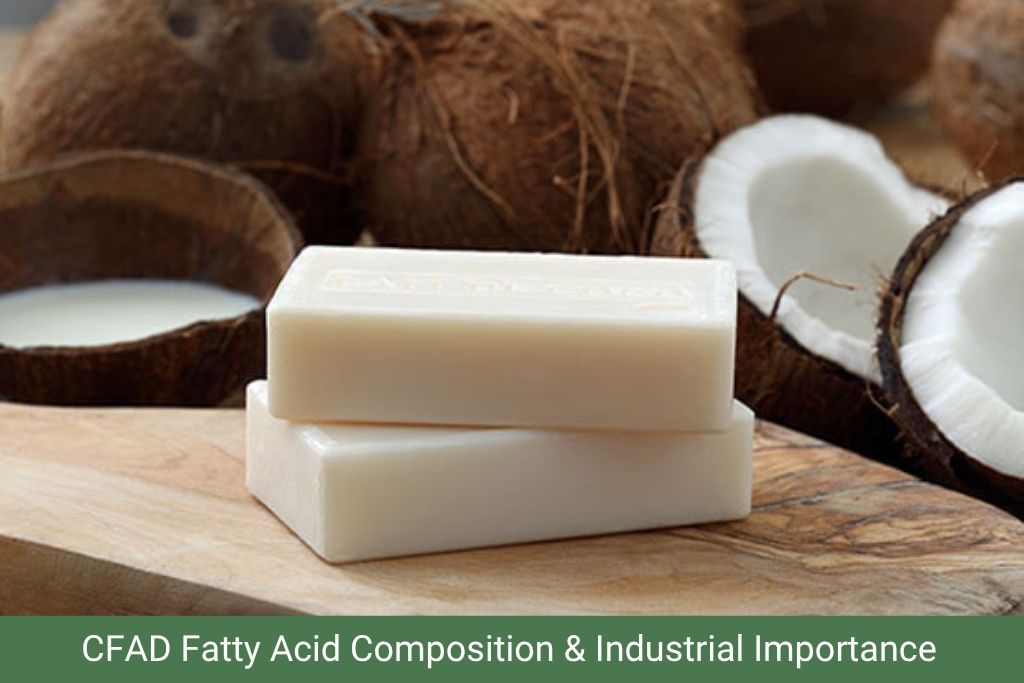
Coconut Fatty Acid Distillate is used across several industrial sectors where its coconut-derived fatty acid profile provides functional benefits. In soap manufacturing, CFAD is used as a cost-effective acidulated fat input in the saponification process to produce soap noodles with enhanced lathering properties. The Free Fatty Acid content of CFAD (typically 85 to 95 percent FFA) makes it directly available for saponification without requiring prior splitting, unlike triglyceride oils. In rubber processing, coconut fatty acids including CFAD are used as processing aids and activators in the vulcanisation of natural rubber, where they contribute to rubber flow properties during compounding and improve the dispersibility of zinc oxide and other vulcanisation agents. In the detergent and surfactant industry, CFAD provides the fatty acid feedstock for the production of sodium and potassium soaps used in liquid soap and detergent formulations, taking advantage of the rapid solubility and high foam profile of coconut-derived lauric acid soaps in water. As a Coconut Fatty Acid Distillate Supplier and CFAD Exporter, Olivia Oleo supplies this product with full fatty acid profile analysis and FFA content documentation to industrial buyers across Asia, Africa, and the Middle East.

How Does CFAD Differ from DCFA and Which One Should Industrial Buyers Choose?
The choice between CFAD and Distilled Coconut Fatty Acid (DCFA) depends on the purity requirements and application of the industrial buyer. CFAD is a co-product stream with Free Fatty Acid content of 85 to 95 percent, containing residual impurities including unsaponifiable matter, colour bodies, and minor oxidation products from the refining process. It is the more economical option and is suitable for applications where fatty acid purity above 85 to 90 percent is sufficient - primarily soap manufacturing, rubber processing, and standard detergent production. DCFA is produced by a dedicated fat splitting and steam distillation process that yields a purer fatty acid product with FFA content above 97 percent, lower colour, and a more precisely controlled fatty acid profile. It is preferred for personal care applications including skin creams, hair care products, and surfactant synthesis where colour, odour, and fatty acid purity specifications are tighter. DCFA Supplier offerings from Olivia Oleo include full fatty acid profile analysis, distillation specifications, and the relevant Halal and food-grade certifications required by personal care and food industry buyers. Buyers sourcing CFAD Wholesale for large-volume industrial applications benefit from Olivia Oleo's ability to supply both products from a single source, allowing quality-performance optimisation by product grade.
What Are the Storage and Handling Requirements for Bulk CFAD Shipments?
Coconut Fatty Acid Distillate is typically liquid above 30 degrees Celsius and semi-solid below this temperature due to its high lauric acid content. For bulk shipments in ISO tank containers or flexi-tanks, the product must be maintained above 35 degrees Celsius during transit and at the receiving terminal to ensure it remains pumpable. Tanks and pipelines in the receiving terminal must be heat-traced or heated before product transfer to prevent solidification. CFAD should be stored in stainless steel or mild steel with epoxy-lined tanks, away from oxygen exposure, and with nitrogen blanketing if long storage is planned, since free fatty acid products are more susceptible to oxidative degradation than triglyceride oils. For smaller-volume buyers, CFAD is also available in lined steel drums of 200 kilograms, which allows the product to be melted in the drum before use without tank infrastructure investment. Olivia Oleo provides full shipping documentation, safety data sheets (SDS), and technical handling guidelines with every CFAD and DCFA shipment.
CFAD and DCFA Sourcing: Selecting the Right Coconut Fatty Acid Grade for Your Industrial Application
Coconut Fatty Acid Distillate is the most cost-effective coconut-derived fatty acid input available for soap manufacturing, rubber vulcanisation, and detergent production, delivering the high lauric acid content and Free Fatty Acid availability that these applications require at a lower cost than fully distilled DCFA. For personal care applications, surfactant synthesis, and processes where tighter fatty acid purity and lower colour are required, DCFA from Olivia Oleo provides the higher specification option from the same coconut supply chain. Both products are available from Olivia Oleo in ISO tank, flexi-tank, and 200-kilogram drum formats with full fatty acid profile analysis, FFA documentation, Halal certification, and safety data sheets provided with every shipment. Contact our export team to discuss CFAD or DCFA specifications and arrange pricing and sample allocation for your application.