

Distilled Coconut Fatty Acid (DCFA) is a critical building block in the oleochemical industry, serving as the primary feedstock for a vast array of products, including soaps, surfactants, cosmetics, lubricants, and medium-chain triglycerides (MCTs). Its value in global trade is entirely reliant on its purity and consistency, which are quantified through a rigid set of analytical standards. Strict quality control ensures the DCFA performs reliably in the client’s industrial process, making adherence to key chemical indices non-negotiable for exporters and manufacturers.

Understanding Distillation: The Basis of Purity
DCFA is obtained by first hydrolyzing crude coconut oil (splitting it into crude fatty acids and glycerin) and then subjecting the crude fatty acids to high-vacuum distillation. This process separates the fatty acids from impurities, residual glycerin, and color bodies.
The distilled product is characterized by its unique composition: a high concentration of medium-chain saturated fatty acids, primarily Lauric Acid (C12) (often 45% or higher) and Myristic Acid (C14). This specific chain length profile gives DCFA its desirable properties, such as excellent foaming (lathering) and cleansing power, which are highly valued in personal care applications.
Read Our Article: Distilled Coconut Fatty Acid in Alkyd Resins - From Coconuts to Canvases
Key Laboratory Parameters for DCFA Quality
The global trade of DCFA is governed by specifications that focus on four primary chemical and physical indices.
Acid Value (AV)
The Acid Value (AV) is the single most critical indicator of DCFA purity and quality. It measures the amount of potassium hydroxide (KOH) required to neutralize the free fatty acids present in one gram of the sample.
- Significance: Since DCFA is predominantly composed of free fatty acids, a high Acid Value indicates high purity and minimal contamination from neutral fats (like unhydrolyzed oil) or other non-acidic impurities.
- International Specifications: Standard industrial-grade DCFA typically mandates an Acid Value in the range of 250 to 275 mg KOH/g. This narrow range is essential because the Acid Value directly impacts the required amount of alkali (e.g., caustic soda) needed by the client to make soap or ester derivatives.
Our Other Product: Soap Noodles
Iodine Value (IV)
The Iodine Value (IV) measures the degree of unsaturation (double bonds) in the fatty acid chains. It is expressed as grams of iodine absorbed by 100 grams of the sample.
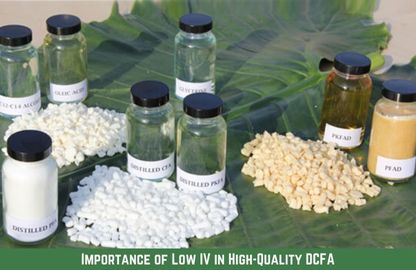
- Significance: Coconut oil is a highly saturated oil (over 90% saturated fats). Therefore, pure, high-quality DCFA should have a very low Iodine Value. A high IV indicates the presence of excessive unsaturated fatty acids (like oleic or linoleic acid), which increases the product's susceptibility to oxidation, leading to instability, discoloration, and rancidity over time.
- International Specifications: Most quality standards require the Iodine Value for DCFA to be Max 10 to Max 18 g I₂/100g. Specialized, low-IV grades may demand even lower values to guarantee maximum oxidative stability for high-end applications like cosmetics.
Color Indices
Color is a vital physical property, as the final appearance of the client's product (e.g., a white soap bar or clear liquid surfactant) depends on the feedstock's clarity. Color is measured using standard methods, most commonly the Lovibond Tintometer scale.
- Measurement: Samples are measured in specific cell sizes (e.g., 1 inch or 5.25 inch) for both red (R) and yellow (Y) units. The specifications are typically set as a maximum, such as 1.0 Red Max and 10 Yellow Max (in a 5.25-inch cell).
- Significance: The distillation process is specifically designed to remove color bodies, which are precursors to color formation and odor. Higher color indices suggest incomplete refining or, more critically, oxidation during storage and transport. Suppliers often provide two color values: Initial Color and After Heat Color (measured after heating the sample to 200 degree for two hours) to prove the product’s thermal stability.
Read Our Article: Fatty Amines from Distilled Coconut Fatty Acid: Applications and Sustainability
Titre (Titer)
Titre is the solidification point or melting point of the fatty acid mixture.
- Significance: This value is determined by the specific composition of the fatty acid chains. Since DCFA is rich in C12 and C14, its Titre point is relatively low but must remain consistent. Titre consistency is crucial for clients who rely on the material to be liquid (or easily melted) for pumping and blending in their manufacturing processes.
- Typical Range: DCFA typically exhibits a Titre in the range of 22°C to 29°C, confirming its characteristic short-to-medium chain profile.

Our Other Product: Refined Glycerine 99.7% USP
International Specifications and Trade Requirements
Global trade demands adherence to specifications set by major industrial bodies and regional standards organizations.
- AOCS (American Oil Chemists' Society) Methods: These are the globally recognized standard test methods (e.g., AOCS Cd 3d-63 for Acid Value or AOCS Cd 1-25 for Iodine Value) that manufacturers must use for analysis, ensuring test results are universally comparable.
- Regional Standards (e.g., BIS in India): Some nations, like India, establish mandatory national standards (e.g., IS 12069:1987 for Coconut Fatty Acids by the Bureau of Indian Standards) that require local or foreign manufacturers supplying the domestic market to adhere to strict parameters.
- The Certificate of Analysis (COA): For every international shipment, the Certificate of Analysis (COA) is the governing legal document. It is the manufacturer's guarantee that the shipment meets the mutually agreed-upon buyer/seller specifications. The COA must precisely state the test methods used and the results for all critical parameters: Acid Value, Iodine Value, Color, and Moisture Content.
By maintaining rigorous quality control over these core chemical indices and providing transparent, standards-compliant documentation, Distilled Coconut Fatty Acid manufacturers ensure their product remains a trusted, high-value commodity in the specialized global oleochemical trade.