

HPKO: The Lauric Fat Behind Cocoa Butter Substitute, Confectionery Coatings, and Personal Care Products
Hydrogenated Palm Kernel Oil, universally known as HPKO, is one of the most technically specialised fats in global oleochemical and food manufacturing. Its unique combination of high lauric acid content and complete saturation produces a fat that behaves like cocoa butter at body temperature, making it the primary feedstock for Cocoa Butter Substitute production and a critical ingredient in compound chocolate, confectionery coatings, wafer cream fillings, and personal care products. Yet its manufacturing process, the specifications that determine its suitability for different grades of application, and the supply chain dynamics that affect its availability and pricing are not always well understood by buyers new to lauric fat procurement. This article provides a complete guide to HPKO, covering its manufacturing process, key technical specifications for confectionery, personal care, and industrial grades, and the logistics considerations for importers and bulk buyers.
What Is Hydrogenated Palm Kernel Oil (HPKO) and Why Is It a Critical Industrial Fat?
Hydrogenated Palm Kernel Oil, universally abbreviated as HPKO, is produced by the full hydrogenation of RBD Palm Kernel Oil in the presence of a nickel catalyst under controlled pressure and temperature conditions. The hydrogenation process converts all remaining unsaturated fatty acid double bonds to saturated bonds, eliminating the residual oleic acid that is naturally present in unhydrogenated palm kernel oil and producing a completely saturated, waxy fat with a very sharp Slip Melting Point typically between 34 and 42 degrees Celsius depending on the processing conditions and the degree of fractionation applied. HPKO is one of the most technically specific fats in the global oleochemicals and food industries because its unique combination of high lauric acid content and complete saturation gives it a melting behaviour that closely mimics cocoa butter - solid at room temperature and rapidly liquid at body temperature - without the polymorphic instability that makes cocoa butter difficult to work with in large-scale confectionery manufacturing. This characteristic is the reason that HPKO is the primary feedstock for Cocoa Butter Substitute production.
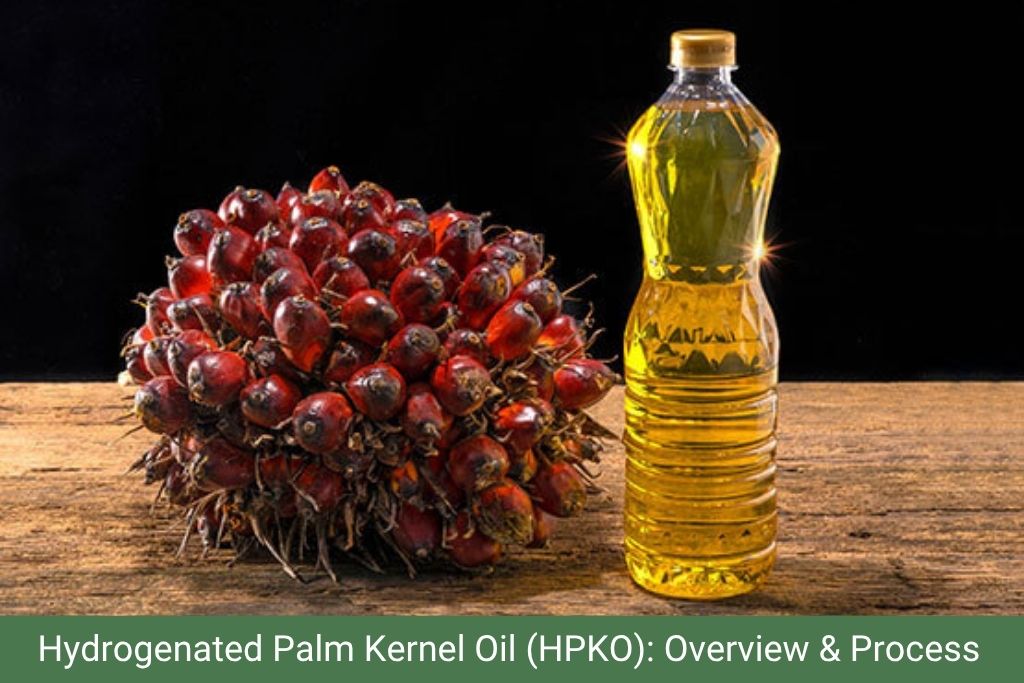
How Is HPKO Manufactured and What Are the Key Process Parameters?
The manufacturing process for Hydrogenated Palm Kernel Oil begins with RBD Palm Kernel Oil as the feedstock. The oil is loaded into a closed reactor vessel and heated to a reaction temperature of 140 to 180 degrees Celsius. Hydrogen gas is introduced under pressure of 2 to 4 bar and a nickel catalyst (typically 0.02 to 0.05 percent by weight of oil) is added. The reaction proceeds until the Iodine Value of the oil falls below 1, confirming full saturation. The catalyst is then filtered from the oil through a filter press or diatomaceous earth filtration system. The product is then refined through a light bleaching and deodorisation step to remove catalyst residues, colour bodies, and any off-flavours developed during the hydrogenation reaction. The resulting refined hydrogenated palm kernel oil is a white to off-white solid fat at room temperature. For confectionery grade HPKO, the standard specification requires Iodine Value below 1, Slip Melting Point between 34 and 36 degrees Celsius, Free Fatty Acid below 0.1 percent, Moisture below 0.1 percent, and Peroxide Value below 2 mEq/kg.
Our Other Products
Soap Noodles - SWSN, MSN, LSN
What Are the Key Specifications of HPKO for Different Applications?
| Parameter | Confectionery Grade CBS | Personal Care Grade | Industrial Grade |
|---|---|---|---|
| Iodine Value | Below 1 | Below 1 | Below 3 |
| Slip Melting Point | 34–36°C | 36–42°C | 38–45°C |
| Free Fatty Acid (as lauric) | Max 0.1% | Max 0.1% | Max 0.5% |
| Peroxide Value | Max 2 mEq/kg | Max 2 mEq/kg | Max 5 mEq/kg |
| Colour (Lovibond 5.25" cell) | Max 3.0R / 30Y | Max 5.0R / 50Y | Not critical |
| Moisture | Max 0.1% | Max 0.1% | Max 0.2% |
| Lauric Acid (C12:0) | 45–52% | 45–52% | 45–55% |
What Are the Main Applications of HPKO in the Confectionery Industry?
In the confectionery industry, HPKO is primarily used as the direct feedstock for Cocoa Butter Substitute (CBS) production. When fully hydrogenated palm kernel oil is fractionated to isolate the hard stearin fraction with a Slip Melting Point of 34 to 36 degrees Celsius, it produces a non-tempering confectionery fat that melts cleanly at body temperature, provides excellent snap when cold, and delivers a smooth, non-waxy mouthfeel similar to cocoa butter. This CBS fat is then applied in compound chocolate, confectionery coatings, chocolate flavoured products, filling fats for wafers and biscuits, and ice cream coating (magic shell) applications. The hpko fat base is also used directly in cream filling formulations for wafer biscuits and cakes, where its sharp melting point ensures that the filling remains firm at room temperature but melts cleanly during consumption without a greasy aftertaste.
How Is HPKO Used in Personal Care and Cosmetic Products?
Hydrogenated Palm Kernel Oil has significant applications in the personal care and cosmetics industry because its high lauric acid content and full saturation make it an effective emollient and structuring agent in a wide range of formulations. In lip care products including lipstick, lip balm, and lip gloss, HPKO contributes body, opacity, and a waxy texture that enables the product to be formed into sticks and maintain its shape across a wide range of storage temperatures. In skin creams and body lotions, HPKO is used as a hard fat phase component that provides a smooth application feel and controlled skin conditioning. In hair care products, coconut and palm kernel derived fats are traditionally valued for their penetrating and conditioning properties, and HPKO contributes to the formulation of hair waxes and styling products where a firm texture at room temperature is required. Hydrogenated Palm Kernel Stearin - the hard fraction of hydrogenated palm kernel oil - is similarly used in candle wax blends and as a release agent in industrial baking.
Our Other Products
Surfactants - SLES, CAPB/Betaine, Fatty Alcohol Ethoxylates, CDEA, LABSAWhat Should Importers and Bulk Buyers Know About HPKO Supply and Logistics?
Hydrogenated Palm Kernel Oil is produced primarily in Indonesia and Malaysia, which together account for the vast majority of global palm kernel processing capacity. The primary production hubs are Sumatera and Kalimantan in Indonesia and Johor and Sabah in Malaysia. Singapore-based traders and exporters, including Olivia Oleo, source HPKO from these production centres and supply to buyers in Africa, the Middle East, South Asia, Europe, and the Americas. HPKO Supplier options include direct mill purchase, which requires larger minimum order quantities and longer lead times, and trader purchase from Singapore which provides more flexible lot sizes, consolidated shipments, and faster documentation turnaround. For first-time importers of HPKO, Olivia Oleo provides samples, advance Certificate of Analysis, and can arrange third-party inspection at origin before shipment. The product is shipped in solid form in 25-kilogram cardboard cartons, in 200-kilogram drums, or in flexi-tanks as liquid above its melting point for bulk tonnage orders.

HPKO Supply and Specifications: What Confectionery Manufacturers and Industrial Buyers Need to Know
Hydrogenated Palm Kernel Oil is an irreplaceable raw material for compound chocolate producers, CBS manufacturers, personal care formulators, and industrial buyers who depend on its sharp lauric melt profile and complete saturation. Its technical performance is entirely determined by the precision of the hydrogenation process and the specification controls applied during manufacturing, making supplier selection a critical decision for any buyer who depends on HPKO for quality-sensitive applications. Olivia Oleo sources HPKO from primary production hubs in Indonesia and Malaysia and supplies it from Singapore to buyers across Africa, the Middle East, South Asia, Europe, and the Americas in 25-kilogram cartons, 200-kilogram drums, and bulk flexi-tank formats. Samples, advance Certificate of Analysis, and third-party inspection at origin are all available for first-time importers. Contact Olivia Oleo to discuss your HPKO specification, grade, and volume requirement.