

Few food ingredients tell the story of Asia's evolving consumer economy as vividly as margarine. Once regarded primarily as a budget alternative to butter in Western markets, margarine has carved out a distinctly different identity across South and Southeast Asia — where it is not a substitute for anything, but rather an ingredient category in its own right, deeply embedded in local baking traditions, street food culture, professional foodservice, and the rapidly expanding packaged food manufacturing sector. Understanding the margarine market across this region in 2026 requires looking beyond simple price-versus-butter comparisons and engaging with the genuine complexity of consumer preferences, cultural food practices, and industrial demand dynamics that make this one of the most interesting edible fat markets in the world.
The Regional Landscape: Why South and Southeast Asia Matter
South and Southeast Asia collectively represent one of the largest and fastest-growing consumption regions for margarine globally. The combined population of countries including India, Indonesia, the Philippines, Vietnam, Thailand, Malaysia, Bangladesh, Sri Lanka, and Myanmar exceeds 2.5 billion people — a consumer base undergoing rapid income growth, urbanisation, and dietary evolution that directly drives margarine demand across both household and industrial channels.
Unlike Western markets where margarine consumption has been under pressure from butter's premium repositioning and health perception shifts, Asian markets are at a different stage of the consumption curve. Rising incomes are expanding access to processed and baked foods. Growing urban middle classes are adopting Western-influenced food habits including bread consumption, pastry eating, and bakery-style café culture. And the region's enormous food manufacturing sector — producing everything from instant noodles and cookies to cakes and confectionery — relies on margarine as a cost-effective, functionally versatile fat system that performs reliably at industrial scale.
Consumer Preferences: How They Vary Across the Region
One of the most important realities of the South and Southeast Asian margarine market is that consumer preferences are far from uniform. Each country has its own food culture, cooking traditions, income profile, and product expectations — and successful margarine brands must navigate this diversity rather than treating the region as a monolithic market.
Indonesia
Indonesia is one of the largest margarine markets in Asia, with deeply embedded cultural use of margarine in home baking, traditional cakes, and everyday cooking. Indonesian consumers use margarine as a cooking fat, bread spread, and baking ingredient interchangeably — and the country's rich tradition of kue (traditional cakes and pastries) has made margarine a household staple rather than an occasional ingredient. Price sensitivity is significant, and margarine price competitiveness is a primary purchase driver across most consumer segments.
Philippines
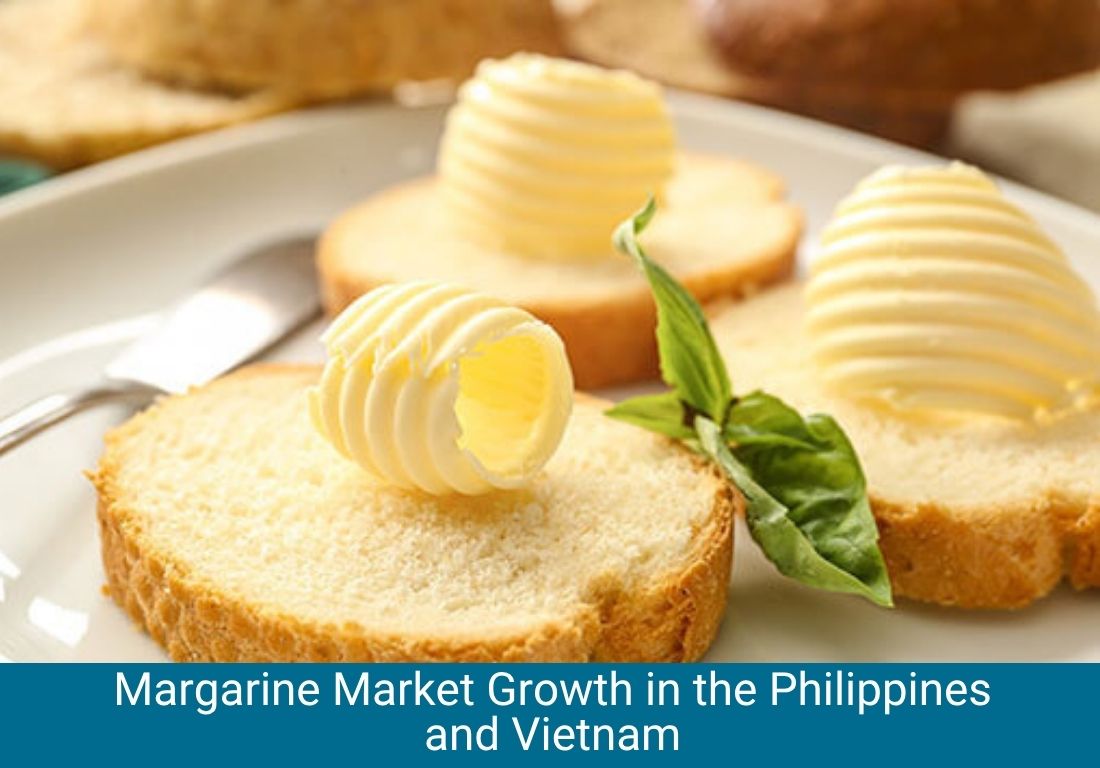
The Philippine margarine market is characterised by high household penetration and strong cultural integration into everyday cooking and baking. Filipino cuisine makes extensive use of margarine as a cooking fat for sautéing, frying, and finishing dishes — a usage pattern that reflects the country's historical exposure to American food culture and the practical cost advantage of margarine over butter for daily household use.
Margarine for baking is a major consumption occasion in the Philippines, where home baking is culturally significant and the country's love of sweet breads, ensaymada, and celebration cakes drives consistent demand. Filipino consumers are increasingly aware of margarine ingredients and nutritional content — a trend that is pushing manufacturers toward trans fat free margarine formulations as health consciousness grows among urban consumers.
Vietnam
Vietnam represents one of the most dynamic growth markets for margarine in Southeast Asia. Rising incomes, rapid urbanisation, and the explosive growth of the café and bakery culture — driven partly by the country's strong coffee culture and partly by Western food influence — have created rapidly expanding demand for margarine for baking in both household and professional channels.
Vietnamese consumers are relatively newer to margarine compared to Indonesian or Filipino consumers, which means brand loyalty is still forming and margarine suppliers with the right product quality and distribution capabilities have genuine market-building opportunities. The foodservice and bakery channels are the primary growth engines, with independent bakeries and café chains representing the most accessible entry points for commercial margarine manufacturers.
Our Other Products
Distilled Fatty AcidsIndia
India's relationship with margarine is complex and distinct from the rest of the region. Traditionally, Indian cooking is dominated by ghee, vegetable oils, and vanaspati (hydrogenated vegetable fat) — and margarine occupies a more limited position in the household cooking fat repertoire than in Southeast Asian markets. However, the industrial and foodservice demand picture is considerably more dynamic.
India's enormous bakery and confectionery manufacturing sector — one of the largest in the world by volume — is a major consumer of industrial margarine and bakery margarine in bulk formats. Biscuits, cookies, cakes, breads, and pastries produced at industrial scale all rely on margarine as a cost-effective fat system. The growth of organised retail, quick service restaurants, and café chains in India's urban centres is driving incremental demand for premium and foodservice margarine grades. Margarine price remains a critical variable for Indian industrial buyers, with procurement decisions highly sensitive to movements in palm oil — the primary feedstock for margarine manufacturing in India.
Thailand and Malaysia
Thailand and Malaysia are mature Southeast Asian markets with well-developed margarine consumption bases across both household and industrial channels. Both countries have significant domestic food manufacturing industries that consume large volumes of margarine bulk supply, and both have established consumer markets with clear preferences for specific texture, flavour, and functional profiles.
Malaysia's status as a major palm oil producer gives its margarine manufacturers a structural feedstock cost advantage — palm oil is the primary fat in most Asian margarine formulations — that supports competitive margarine price positioning both domestically and for export into regional markets. Malaysian margarine exporters supply significant volumes across Southeast Asia and beyond.
Key Market Dynamics Shaping the Regional Industry
Palm Oil as the Dominant Feedstock
The overwhelming majority of margarine produced and consumed across South and Southeast Asia is palm oil-based. Palm oil margarine dominates for straightforward reasons — palm oil is abundantly available, competitively priced relative to alternative fats, and has the right physical properties (semi-solid at room temperature) to serve as an effective margarine base with relatively simple processing.
Margarine manufacturing in Asia typically involves blending refined palm oil, palm stearin, and sometimes palm kernel oil or other vegetable oils with emulsifiers, salt, flavour compounds, and vitamins to achieve target texture, melt profile, and sensory characteristics. The close relationship between palm oil price and margarine price means that movements in the global palm oil market flow directly through to margarine production costs — a dynamic that both manufacturers and industrial buyers must actively manage.
The Trans Fat Elimination Transition
One of the most significant structural shifts affecting the Asian margarine market in 2026 is the ongoing transition away from partially hydrogenated vegetable oils — the source of industrially produced trans fatty acids — toward trans fat free margarine formulations based on interesterification and fractionation technologies.
The World Health Organisation's REPLACE initiative and regulatory actions by countries including India, the Philippines, and Thailand to limit or eliminate industrial trans fats in food products have created both a compliance imperative and a market opportunity. Margarine manufacturers who have invested in interesterification capability and clean-label formulation technology are well positioned to capture share as the transition accelerates. For industrial buyers of bakery margarine and shortening, confirming trans fat status and regulatory compliance has become a standard procurement requirement.
Health and Nutrition Trends
Urban consumers across South and Southeast Asia are becoming increasingly aware of the nutritional content of the foods they consume — and margarine is not immune to this scrutiny. The category faces a dual challenge: managing legacy perceptions around trans fats on one hand, while capitalising on genuine product improvements and functional benefits on the other.
Margarine benefits that resonate with health-aware Asian consumers include fortification with vitamins A and D — particularly relevant in markets where micronutrient deficiency is a public health concern — reduced saturated fat versus butter, plant-based origin, and in some premium segments, the incorporation of functional ingredients like omega-3 fatty acids or phytosterols.
Plant-based margarine positioning is gaining traction in urban markets across India, Thailand, and Vietnam, riding the broader plant-based food trend that has penetrated Asian consumer consciousness through social media, health influencer culture, and the growing availability of plant-based products in modern retail formats.

Foodservice and Bakery Channel Growth
Across the region, the most dynamic demand growth for margarine is coming from the professional foodservice and artisan bakery channels rather than household retail. The explosion of café culture, independent bakeries, quick service restaurants, hotel breakfast operations, and cloud kitchens across tier-1 and tier-2 cities in Indonesia, Vietnam, India, Thailand, and the Philippines is creating strong incremental demand for bakery margarine, puff pastry margarine, and croissant margarine — speciality grades with specific functionality requirements that command premium pricing over commodity household margarine.
Margarine for croissants and laminated pastry applications requires precise melting behaviour, plasticity ranges, and fat crystal structures that are technically distinct from general-purpose margarine — and the growing number of artisan and semi-industrial bakeries across the region are creating an entirely new demand category for technically sophisticated margarine suppliers with product development capability.
Our Other Products
Soap NoodlesOutlook: Where the Market Goes From Here
The trajectory for margarine across South and Southeast Asia is fundamentally positive — though the nature of growth is shifting. Volume growth in household consumption will be moderate in mature markets like Indonesia and the Philippines, but meaningful in emerging markets like Vietnam, Bangladesh, and Myanmar where per-capita consumption remains well below regional averages.
The real growth engine is the industrial and foodservice channel — driven by the continued expansion of packaged food manufacturing, café and bakery culture, and quick service restaurant penetration across the region's rapidly urbanising population centres. For margarine manufacturers and margarine suppliers with the product range, technical capability, and distribution infrastructure to serve these channels, South and Southeast Asia represents one of the most compelling growth opportunities in the global edible fats market.
Health, and trans fat elimination will continue to shape product development priorities — and the margarine brands that invest in clean-label formulations, nutritional fortification, and transparent ingredient communication will be best positioned to capture the loyalty of Asia's increasingly informed and demanding consumer base.