

Latin America is quietly becoming one of the most compelling growth stories in the global oleic acid market. While much of the industry's attention has historically been focused on European and Asian demand centres, 2026 is proving to be a pivotal year for oleic acid consumption across Latin American industrial markets — driven by expanding manufacturing capacity, rising consumer spending on personal care and food products, and a regional push toward bio-based industrial inputs. For every oleic acid supplier, oleic acid manufacturer, and bulk buyer with eyes on emerging markets, Latin America deserves serious attention.
What Is Oleic Acid and Why Is It Industrially Significant?
Its industrial significance stems directly from its versatility. Oleic acid uses span personal care and cosmetics, food processing, pharmaceuticals, lubricants, textiles, rubber manufacturing, and metal processing — a breadth of application that makes it a foundational input across virtually every industrial sector. This multi-sector demand profile is one of the key reasons the Latin American market is so interesting: as the region's industrial base diversifies and grows, oleic acid consumption grows alongside it across multiple channels simultaneously.
Understanding oleic acid benefits in each of these applications helps explain why demand is so structurally durable. In personal care, its skin-conditioning and penetration-enhancing properties are irreplaceable. In food, its role in heart-healthy formulations drives consumer preference. In industrial lubricants and metalworking fluids, its thermal stability and lubricity make it a preferred bio-based alternative to petroleum-derived inputs.

The Latin American Market: A Regional Overview
Latin America encompasses a diverse range of economies at different stages of industrial development, and oleic acid demand reflects this diversity. Brazil, Mexico, Argentina, Colombia, Chile, and Peru represent the largest markets, each with distinct industrial profiles and demand drivers.
Brazil is by far the dominant consumer, with its enormous food processing industry, rapidly growing personal care sector, and established oleochemical manufacturing base all contributing to substantial oleic acid demand. Brazil is also a significant producer of oleic-rich vegetable oils — particularly high-oleic sunflower oil — giving it a degree of domestic supply capability that other regional markets lack.
Mexico follows closely, with its large manufacturing economy — including significant automotive, food, and personal care production — creating steady industrial demand. Mexico's proximity to the United States also means it participates in North American supply chains where oleic acid bulk procurement is often standardised across borders.
Argentina and Colombia represent mid-sized but fast-growing markets, particularly in food processing and personal care manufacturing. Chile and Peru are smaller in volume but show above-average growth rates as their consumer economies mature and domestic manufacturing capacity expands.
Read Our Article
Oleic Acid in Detergents: Breaking Boundaries in CleaningOleic Acid in Food: A Primary Demand Driver
Across Latin America, oleic acid in food applications represents one of the largest and fastest-growing demand categories. The regional food processing industry is vast — Latin America is a global powerhouse in food production and export — and oleic acid plays multiple roles within it.
As a food-grade fatty acid, oleic acid is used in frying oils, margarine production, bakery fat formulations, and as a processing aid in confectionery manufacturing. Its high thermal stability makes it particularly valuable in high-temperature food processing applications where less stable fatty acids would oxidise and degrade product quality.
Beyond processing, the nutritional profile of oleic acid has become a significant marketing driver in the region's food industry. Oleic acid benefits for cardiovascular health — well established in scientific literature — have made high-oleic formulations increasingly attractive to health-conscious Latin American consumers. Food manufacturers across Brazil, Mexico, and Colombia have responded by reformulating products with higher oleic acid content, driving incremental demand growth that is distinct from pure volume expansion.
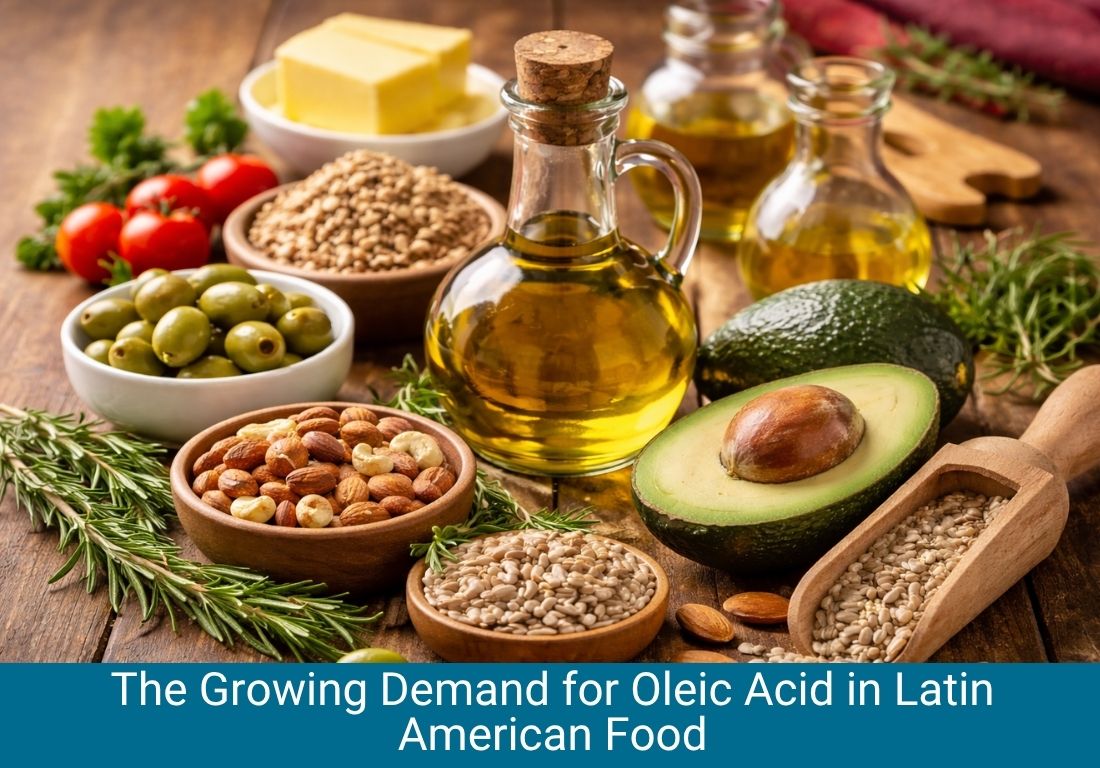
The growing Latin American functional food and nutraceutical sector is adding another layer of demand, with oleic acid featured in omega-enriched products, dietary supplements, and speciality nutritional formulations aimed at an expanding middle-class consumer base.
Our Other Products
Fatty AlcoholsPersonal Care and Cosmetics: Rapid Growth Sector
The Latin American personal care market is one of the fastest-growing in the world — Brazil alone ranks among the top five global personal care markets by value — and this growth is translating directly into rising oleic acid supplier activity across the region.
Oleic acid in cosmetics functions as an emollient, skin conditioner, penetration enhancer, and carrier for active ingredients. Its lightweight texture and excellent skin compatibility make it a preferred ingredient in moisturisers, serums, hair oils, lip products, and cleansing formulations. As Latin American consumers — particularly in Brazil, Mexico, and Colombia — trade up to more sophisticated personal care formulations, manufacturers are incorporating higher-quality fatty acid inputs including pharmaceutical and cosmetic-grade oleic acid.
The rise of domestic beauty brands across the region is particularly notable. Brazilian cosmetics brands have achieved global recognition, and a new generation of clean-beauty and natural formulation companies across Mexico and Colombia are building product lines where bio-based ingredients like oleic acid are positioned as active selling points rather than mere functional inputs. This premiumisation trend is pushing demand toward higher-purity grades and certified sourcing — factors that are increasingly shaping procurement decisions and oleic acid price conversations between buyers and suppliers.
Industrial and Lubricant Applications: The Underappreciated Demand Driver
While food and personal care often dominate discussions of oleic acid demand, industrial applications represent a substantial and often underappreciated share of Latin American consumption. The region's manufacturing sectors — automotive components, metalworking, mining, rubber processing, and textiles — are all significant consumers of oleic acid-based inputs.
In metalworking and machining operations, oleic acid is a key component of cutting fluids, rolling oils, and rust-preventive coatings. Its lubricity and corrosion-inhibiting properties make it effective and economically attractive compared to fully synthetic alternatives. Mexico's large automotive manufacturing sector — the country is one of the world's top vehicle producers — generates consistent industrial demand for these applications.
Brazil's mining industry, one of the largest globally, uses oleic acid as a flotation agent in mineral processing operations — a highly specialised but volume-significant application that few discussions of this market adequately capture. Argentina and Chile's agricultural equipment manufacturing sectors similarly consume oleic acid-based lubricants and processing aids.
As Latin American governments and industrial buyers increasingly prioritise bio-based and biodegradable alternatives to petroleum-derived industrial chemicals, oleic acid's positioning as a naturally derived, performance-proven input is becoming a meaningful competitive advantage for oleic acid manufacturer partners serving these markets.
Read Our Article
Oleic Acid as a Plastic Auxiliary - Plasticizing PowerOleic Acid Price Dynamics in Latin America
Oleic acid price in Latin American markets is shaped by a combination of global and regional factors that buyers and procurement managers must navigate carefully in 2026.
Feedstock Costs: The primary raw materials for oleic acid production — olive oil, high-oleic sunflower oil, canola oil, and tallow — are subject to their own supply and demand dynamics. In 2026, high-oleic sunflower oil supply has been affected by production uncertainties in key growing regions, contributing to upward pressure on oleic acid input costs that is being felt across all markets, including Latin America.
Import Dependency: With the exception of Brazil, most Latin American markets are heavily dependent on imported oleic acid from European, Asian, and North American oleic acid manufacturer facilities. This import dependency means that freight costs, currency exchange rates, and global supply availability all directly influence the landed oleic acid price that regional buyers pay.
Currency Volatility: Currency fluctuation is a persistent feature of Latin American markets. The Brazilian Real, Mexican Peso, Argentine Peso, and Colombian Peso have all experienced periods of significant volatility against the USD — which is the standard invoicing currency for most oleic acid international trade. This currency exposure adds a layer of cost unpredictability for buyers and makes forward contract discussions with oleic acid suppliers particularly valuable.
Tariff Structures: Import tariffs on oleic acid and related fatty acid products vary across Latin American nations and trade blocs. Understanding the tariff environment — and how free trade agreements such as the Pacific Alliance or Mercosur influence duty rates — is an important part of total cost calculation for any buyer evaluating oleic acid bulk procurement from international sources.

Sourcing Strategy: What Latin American Buyers Should Prioritise
For procurement professionals across the region engaging with oleic acid suppliers in 2026, several strategic considerations stand out.
Grade Clarity: Oleic acid is available in technical, food, cosmetic, and pharmaceutical grades, each with distinct purity specifications and pricing. Specifying the required grade precisely at the outset of supplier conversations avoids costly misalignment and ensures regulatory compliance in end-use applications.
Supplier Diversification: Given currency and logistics volatility in the region, relying on a single oleic acid supplier or origin country introduces concentration risk. Developing relationships with multiple oleic acid manufacturer partners across Europe, Asia, and domestic sources where available provides procurement flexibility and negotiating leverage.
Bulk Purchasing Efficiency: For high-volume industrial and food processing buyers, strategically timed oleic acid bulk purchases during periods of favourable pricing and exchange rates can deliver meaningful cost savings over spot procurement throughout the year.
Our Other Products
Glycerine Refined USP Food GradeOutlook: Latin America's Oleic Acid Market Through 2026 and Beyond
The structural growth drivers for oleic acid demand across Latin American industrial markets are firmly in place. A growing middle class expanding personal care consumption, a food industry reformulating toward healthier profiles, an industrial manufacturing base increasingly favouring bio-based inputs, and a regional agenda pushing away from petroleum-derived chemicals — all of these trends point in the same direction.
Oleic acid benefits align almost perfectly with where Latin American industries are heading: natural origin, functional performance, and acceptability. For oleic acid manufacturers and oleic acid suppliers with the capability to serve these markets reliably — with competitive pricing, certified quality, and strong logistics partnerships — Latin America offers genuine long-term growth opportunity that is only beginning to be fully realised.
The businesses that build regional expertise, establish trusted supplier relationships, and invest in understanding the nuanced demand profiles of individual Latin American markets will be the ones best positioned to capture the significant value this region represents in the global oleic acid trade.