In the global oleochemical and fatty acid trade, few raw materials generate as much procurement interest — or as much confusion — as PFAD and PKFAD. Both are co-products of palm oil refining, both are traded in significant volumes across industrial markets, and both serve overlapping yet distinct end-use applications. Yet despite their similar origins and names, they are fundamentally different materials with different fatty acid compositions, different performance characteristics, and different value propositions for industrial buyers.
Whether you are tracking PFAD price movements, evaluating PFAD suppliers for bulk procurement, or trying to determine which material best fits your industrial application, this comprehensive comparison will give you the clarity you need.
Defining the Two Materials
What Is PFAD?
PFAD — Palm Fatty Acid Distillate — is a by-product generated during the physical refining of crude palm oil. When crude palm oil is refined through a process of distillation to remove free fatty acids, impurities, and odour compounds, the material removed in this distillation step is PFAD. Also widely referred to as palm distillate oil in trade and procurement contexts, PFAD is a complex mixture of free fatty acids, glycerides, squalene, vitamin E (tocopherols and tocotrienols), and sterols.
The fatty acid profile of PFAD closely mirrors that of crude palm oil itself — which means it is rich in palmitic acid (typically 44–48%) and oleic acid (typically 30–36%), with smaller amounts of linoleic, stearic, and myristic acids. This composition makes PFAD a versatile and cost-effective industrial feedstock with an impressive range of downstream applications.
What Is PKFAD?
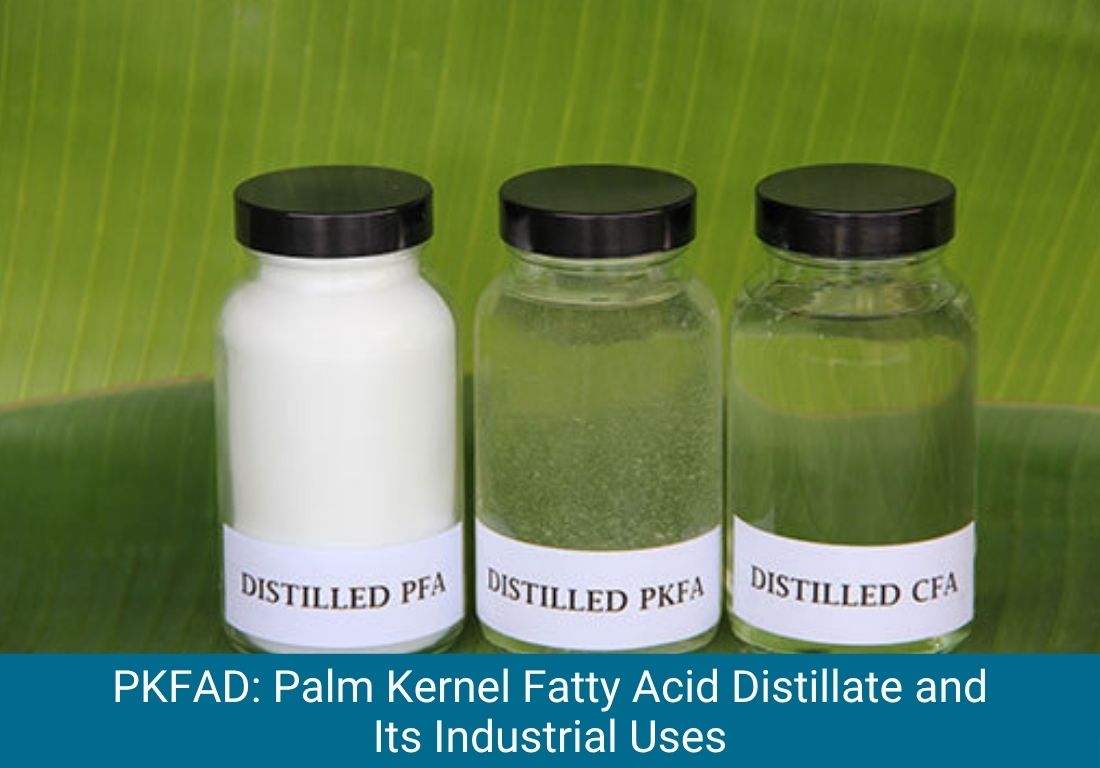
PKFAD — Palm Kernel Fatty Acid Distillate — is the equivalent co-product generated during the refining of crude palm kernel oil rather than crude palm oil. Palm kernel oil has a fundamentally different fatty acid composition from palm oil — it is rich in lauric acid (typically 46–50%) and myristic acid (14–18%), with smaller proportions of oleic, palmitic, and caprylic acids.
This lauric-dominant fatty acid profile gives PKFAD a completely different set of physical and chemical properties compared to PFAD — and consequently a different set of industrial use cases. PKFAD is a medium-chain fatty acid-rich material, making it more closely aligned with coconut oil derivatives than with mainstream palm oil products.
Key Differences: A Side-by-Side Comparison
Understanding the differences between PFAD and PKFAD begins with their raw material origins and flows through to their physical properties, fatty acid compositions, and industrial applications.
Origin: PFAD derives from crude palm oil refining; PKFAD derives from crude palm kernel oil refining. Palm oil and palm kernel oil come from different parts of the oil palm fruit — the mesocarp and the kernel respectively — and have distinct chemical identities despite sharing the same plant origin.
Fatty Acid Profile: PFAD is palmitic and oleic acid-dominant — a long-chain fatty acid mixture. PKFAD is lauric and myristic acid-dominant — a medium-chain fatty acid mixture. This is the single most important difference between the two materials and is the primary determinant of their respective industrial applications.
Physical State: PFAD is typically semi-solid to liquid at room temperature, with a melting point influenced by its high palmitic acid content. PKFAD has a lower melting point and is generally more fluid at ambient temperatures, reflecting its medium-chain fatty acid composition.
Colour and Odour: Both materials carry colour and odour characteristics from their parent oils, but PFAD typically has a darker colour and stronger odour than PKFAD. Both require further processing for applications demanding high purity or neutral sensory profiles.
Availability and Volume: PFAD is produced in significantly larger volumes than PKFAD, reflecting the much greater global production of palm oil versus palm kernel oil. This higher availability directly influences PFAD price — PFAD is generally more competitively priced than PKFAD on a per-tonne basis, making it attractive for large-scale industrial PFAD uses.
Geographic Production: Both materials are produced primarily in Malaysia and Indonesia, the world's dominant palm oil and palm kernel oil producers. PFAD suppliers and PKFAD suppliers are therefore largely concentrated in the same geographic region, though PKFAD supply is more limited given the smaller scale of palm kernel oil refining relative to palm oil refining.

PFAD Uses: Industrial Applications
PFAD uses are among the broadest of any oleochemical co-product, which is a key reason why demand from PFAD manufacturers and downstream industrial buyers remains consistently strong.
Animal Feed and Ruminant Nutrition
One of the largest volume PFAD uses globally is in animal nutrition — specifically as an energy supplement in ruminant feed. PFAD's high energy density, digestibility, and cost-effectiveness make it a preferred fat supplement for dairy cattle, beef cattle, and other ruminants. Its palmitic acid content is particularly valued for supporting milk fat production in dairy operations. This application absorbs enormous volumes of PFAD annually and is a primary driver of PFAD price dynamics in producing regions.
Soap and Detergent Manufacturing
The free fatty acid content of PFAD — particularly its palmitic and oleic acid fractions — makes it a cost-effective feedstock for soap noodle and detergent manufacturing. PFAD suppliers serving soap manufacturers offer a material that can partially or fully substitute for more expensive refined fatty acids in formulations where colour and odour can be managed through the manufacturing process. Industrial soap bars and laundry detergents are the primary end products.
Oleochemical Feedstock
PFAD serves as a feedstock for the production of fatty acids, fatty alcohols, and other oleochemical derivatives. PFAD manufacturers and oleochemical processors use it as an economical source of palmitic and oleic acid fractions that can be separated and purified for downstream use in personal care, food, and industrial applications.
Our Other Products
Soap Noodles - SWSN, MSN, LSN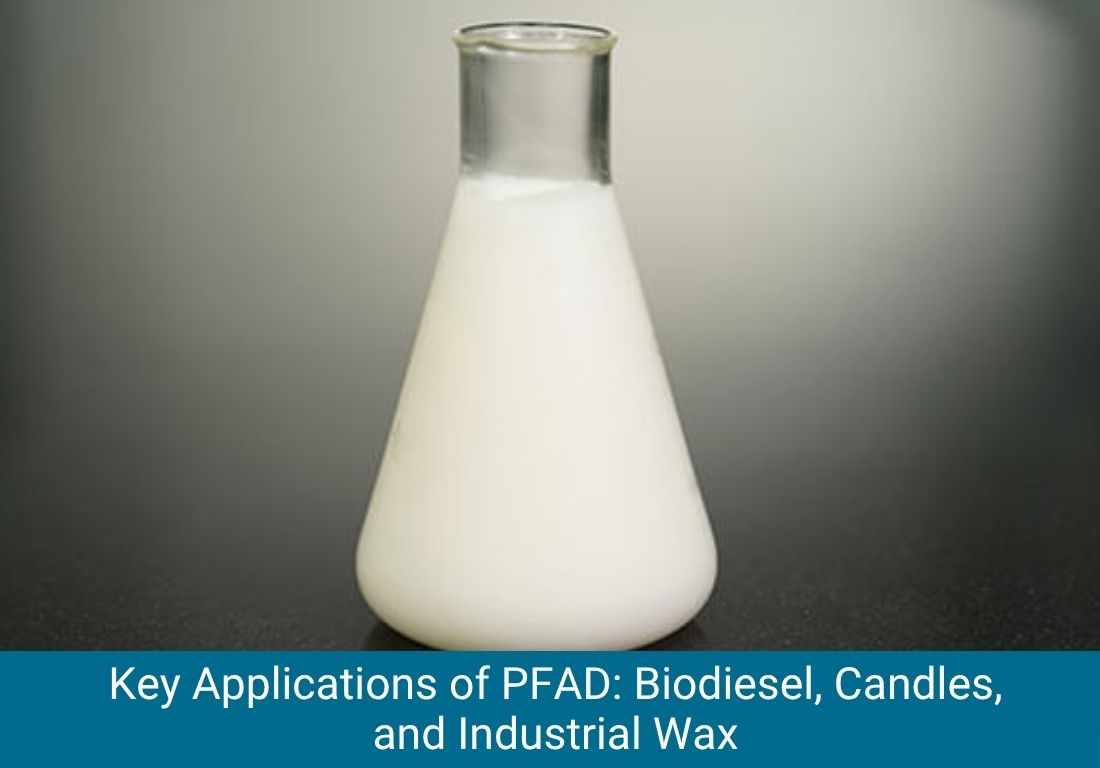
Biodiesel Production
Palm distillate oil has established itself as a significant feedstock for biodiesel production, particularly in Malaysia and Indonesia where national biofuel mandates drive substantial domestic consumption. PFAD's high free fatty acid content is well-suited to acid-catalysed transesterification processes used in certain biodiesel production routes, and its relatively low cost compared to refined palm oil makes it economically attractive as a biofuel feedstock.
Candles and Industrial Wax
The palmitic acid-rich composition of PFAD makes it suitable for candle manufacturing and industrial wax applications, where its semi-solid character and reasonable melting point are functional advantages.
PKFAD Uses: Industrial Applications
PKFAD's medium-chain, lauric-dominant fatty acid profile gives it a distinct set of industrial applications that differ meaningfully from those served by PFAD.
Soap and Personal Care — Premium Applications
PKFAD's lauric acid content gives soaps made from it excellent lathering, cleansing, and antimicrobial properties. Unlike PFAD-based soaps, which tend toward harder bars with moderate lather, PKFAD-derived soaps produce the rich, stable foam associated with premium personal care products. This makes PKFAD a valued feedstock for personal care manufacturers targeting higher-quality formulations — though its higher cost relative to PFAD means it is typically used selectively rather than as a bulk base material.
Lauric Acid and Derivatives Production
Because PKFAD is rich in lauric and myristic acids, it serves as a feedstock for the production of medium-chain fatty acids and their derivatives — including lauric acid, myristic acid, methyl esters, and fatty alcohols. These derivatives find application across cosmetics, pharmaceuticals, food emulsifiers, and specialty industrial chemicals. The growing demand for lauric acid-based ingredients in personal care and pharmaceutical formulations has supported consistent demand for PKFAD as an upstream feedstock.
Animal Feed — Poultry and Swine
Medium-chain fatty acids from PKFAD — particularly lauric acid — have demonstrated antimicrobial and growth-promoting properties in poultry and swine nutrition. As the global animal feed industry moves away from antibiotic growth promoters under regulatory pressure, PKFAD-derived medium-chain fatty acid supplements have gained significant traction as natural alternatives, driving incremental demand growth.
Surfactant Manufacturing
Lauric and myristic acid-derived surfactants — produced from PKFAD as a feedstock — are widely used in personal care cleansers, household detergents, and industrial cleaning formulations. The mild, effective surfactancy of medium-chain fatty acid derivatives makes them preferred ingredients in premium and natural cleaning product formulations.
PFAD Price and Market Dynamics
For buyers looking to buy PFAD bulk, understanding PFAD price drivers is essential for effective procurement planning. PFAD pricing is fundamentally tied to crude palm oil (CPO) prices — since PFAD is a refining co-product, its value is determined by CPO market dynamics, refining margins, and competing demand from its multiple end-use sectors.
In 2026, PFAD price has been influenced by elevated CPO production costs in Malaysia and Indonesia — driven by higher fertiliser costs, labour availability challenges, and tighter palm oil export levy structures. Biodiesel demand has provided a strong price floor, as national biofuel mandates in both Indonesia and Malaysia ensure consistent domestic absorption of available PFAD volumes.
For international buyers seeking to buy PFAD bulk from PFAD suppliers in Malaysia or Indonesia, freight costs, port availability, and currency movements between the USD and MYR or IDR add layers of cost variability that should be factored into total landed cost calculations. Establishing forward supply agreements with reliable PFAD suppliers during periods of price stability can meaningfully reduce procurement cost exposure.
PKFAD pricing follows a similar structural logic — tied to crude palm kernel oil markets — but tends to trade at a premium to PFAD reflecting its lower availability and the higher value of its lauric acid-rich fatty acid profile.

Choosing Between PFAD and PKFAD: A Practical Guide
The choice between PFAD and PKFAD for any given industrial application ultimately comes down to three questions: What fatty acid profile does your application require? What quality and purity level is needed? And what is the total cost of procurement relative to the value delivered?
For applications requiring long-chain fatty acids — soap manufacturing from palm-derived materials, animal feed energy supplementation, biodiesel production, or oleochemical feedstock processing — PFAD is typically the more cost-effective and readily available choice. Its larger supply volumes, established PFAD suppliers network, and competitive PFAD price make it the default option for high-volume industrial buyers.
For applications requiring medium-chain, lauric-dominant fatty acid inputs — premium soap manufacturing, lauric acid derivative production, poultry and swine nutrition supplements, or medium-chain surfactant feedstocks — PKFAD is the appropriate choice despite its higher cost, because no amount of PFAD can replicate the performance characteristics that lauric acid provides.
Our Other Products
SurfactantsConclusion
PFAD and PKFAD are complementary rather than competing materials — each with a clearly defined industrial role shaped by its fatty acid composition and the performance requirements of its end-use applications. Understanding these differences is fundamental to making sound procurement decisions, whether you are evaluating PFAD suppliers, planning to buy PFAD bulk for animal feed or soap manufacturing, or sourcing PKFAD for lauric acid derivative production.
As both materials continue to play important roles across animal nutrition, oleochemicals, personal care, and biodiesel in 2026 and beyond, buyers and PFAD manufacturers who invest in understanding these distinctions — and build supply relationships accordingly — will be best positioned to extract maximum value from two of the oleochemical industry's most versatile co-products.