

The soap noodles industry, a critical yet often overlooked component of the global personal care and cleaning supply chain, faces a unique set of challenges that span chemical stability, climate control, processing efficiency, and complex logistics. The pursuit of high-quality finished soap bars starts with flawlessly executed soap noodle processing and meticulous handling. Addressing common issues from rancidity in storage to breakage during transport requires integrated problem-solving and adherence to specialized best practices.
Troubleshooting Common Issues During Soap Noodle Processing
Soap noodle production involves the precise chemical reaction of saponification, followed by crucial drying and pelletizing steps. Flaws in these stages can immediately compromise the quality and yield of the final product.
| Problem | Root Cause in Soap Noodle Processing | Soap Noodles Solution and Best Practice |
|---|---|---|
| High Free Alkali / Lye-Heavy | Incorrect oil-to-lye ratio; Lye concentration not accurately measured; Insufficient mixing or reaction time. | Process Control: Use precise automated dosing systems for oils and lye. Ensure vigorous, continuous mixing until saponification is complete. Perform regular titration tests on neat soap before drying. |
| Too Soft or Greasy Noodles | Excess oil (high superfat); High Total Fatty Matter (TFM) content combined with high moisture. | Formulation Adjustment: Adjust the recipe to reduce the excess oil percentage. Drying Control: Optimize the vacuum spray dryer or pelletizer to achieve the target moisture content (typically 10-13%). Cooler processing temperatures can also help the base firm up. |
| Rancidity/Off-Odor in Fresh Noodles | Poor quality raw material (oxidized oils/fats, high Free Fatty Acids); Metal contamination accelerating oxidation. | Raw Material Management: Only use fresh, low-FFA oils with low iodine values. Additives: Introduce chelating agents (like EDTA) to deactivate trace metals and antioxidants (like BHT or Tocopherols) immediately after saponification to prevent oxidation. |
| Discoloration/Dark Spots | Overheating during saponification/drying; Trace metal contamination (especially iron or copper) from equipment; Uneven mixing of optical brighteners. | Equipment Check: Ensure stainless steel equipment is free of corrosion. Temperature Control: Monitor and maintain stable temperatures during the high-heat phases (e.g., 80°C to 95°C) to prevent scorching. |
| Soda Ash Formation | Reaction of excess, unsaponified lye with carbon dioxide in the air, often due to high residual moisture or slow cooling. | Drying: Achieve optimal low-end moisture content. Cooling: Ensure rapid and uniform cooling of the noodles after extrusion to inhibit surface reactions. |
Managing Odor Challenges in Soap Noodle Storage
Odor in soap noodles is almost always a direct consequence of rancidity, a chemical degradation that severely limits their shelf life and applicability in premium soap bars. This rancidity can be oxidative (reaction with air) or hydrolytic (reaction with water).

Preventing Rancidity and Odor
- Chemical Mitigation (Antioxidants & Chelators):
- Antioxidants: Incorporate food-grade antioxidants (Rosemary Oleoresin Extract - ROE, or BHT) into the fatty oil feedstock before saponification. These molecules sacrifice themselves to protect the unsaturated fatty acids.
- Chelators: The single most effective measure is adding a chelating agent (like Citrate or EDTA) to bind trace metal ions (copper and iron) that act as catalysts for oxidation, thereby stopping the rancidity cycle before it begins.
- Moisture Control: Maintain the Total Moisture Content (TMC) within the tight specification range (e.g., 10-14%). Excess moisture promotes hydrolytic rancidity and microbial growth, leading to spoilage and odor.
- Airtight Packaging: Use high-barrier packaging, such as heavy-duty, multi-layered Polypropylene (PP) or Polyethylene (PE) bags, which offer excellent protection against oxygen and environmental moisture. Vacuum sealed packaging is the best defense against oxidative rancidity for long-term storage.
- Inventory Management: Implement a strict First-In, First-Out (FIFO) inventory system to ensure older batches are used first, minimizing the time noodles spend in storage.
Read Our Article: How Soap Noodles Are Used in the Production of Various Types of Soaps?
How Climate Conditions Affect Soap Noodle Performance in Manufacturing
Climate conditions, particularly in the tropical and sub-tropical regions where much of the soap manufacturing capacity is located, pose significant environmental stress on soap noodles.
Impact of High Humidity (Hygroscopicity)
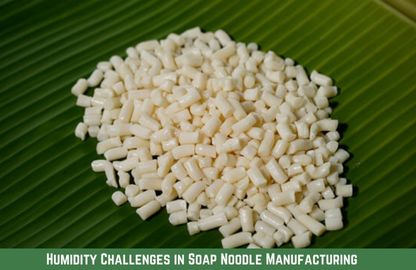
White Soap noodles are hygroscopic, meaning they readily absorb moisture from the surrounding air.
- Manufacturing Performance: In high-humidity climates (Humidity > 70%), stored noodles absorb water, causing their moisture content to rise above specification. This leads to:
- Clumping and Softening: Noodles stick together, making bulk handling difficult and clogging conveyors.
- Processing Issues: The softened noodles become too sticky for the plodder/extruder, leading to poor soap bar structure, mushiness, and rapid dissolution in use.
- Solution: Storage areas must be climate-controlled with dehumidification systems to maintain relative humidity below 60%. Packaging integrity must be impeccable to prevent moisture ingress.
Impact of High Temperature
High ambient temperatures accelerate undesirable chemical reactions.
- Chemical Degradation: Temperatures above 25°C accelerate both oxidation and hydrolysis, drastically reducing the effective shelf life and promoting rancidity, even if packaged well.
- Physical Deformation: Prolonged exposure to high heat (especially above 30°C) can cause the noodles to soften, distort their shape, and fuse together, making re-processing difficult.
- Solution: Storage facilities should be cool and shaded, ideally maintaining temperatures between 15°C and 25°C, especially for high-TFM grades.
Reducing Breakage and Powder Formation in Soap Noodles During Transport
Soap noodles are brittle and susceptible to attrition (breakage and dust formation) during handling, leading to a loss of usable product and an increase in hazardous dust.
Formulation Control (Hardness):
- The soap's fatty acid profile directly influences its brittleness. Noodles made from a higher proportion of saturated fats (C16-C18, e.g., Tallow or Palm) are harder and more resistant to breakage than those made from unsaturated fats (e.g., Coconut or Palm Kernel).
- Process control must ensure the optimal moisture content is achieved; noodles that are too dry (<10% M.C.) are excessively brittle.
Packaging & Cushioning:
- Utilize sturdy, woven polypropylene bags (25 kg or 1000 kg bulk bags) with inner plastic liners. The use of a thick inner liner provides an extra layer of cushioning against impact.
- For palletized transport, ensure proper shrink-wrapping and robust corner protection to stabilize the load and prevent shifting, which causes friction and breakage.
Handling Protocol:
- Minimize Drops: Train logistics teams to minimize the height from which bags are dropped during loading and unloading. Even a short drop can shatter the brittle noodles.
- Avoid Over-Stacking: Do not exceed the safe stacking height recommendation to prevent crushing and compaction of the lower layers, which generates dust and warps the noodle shape.
Best Practices for Bulk Handling & Conveying Soap Noodles
Efficiently moving large volumes of soap noodles within a manufacturing plant requires systems designed to preserve the physical and chemical integrity of the material.
Selecting the Right Conveying System:
- Mechanical Conveyors (e.g., Screw/Belt): Are suitable for short, horizontal distances. However, they must be run slowly to prevent attrition caused by shear and friction. Belt conveyors are gentler than screw conveyors, provided transfer points are minimized.
- Pneumatic Conveying: Often used for long distances. Dense Phase pneumatic conveying is highly recommended over dilute phase. Dense phase moves the material in slugs at low air velocity (e.g., 2 m/s to 10 m/s), drastically reducing particle breakage and pipe wear compared to the high-velocity air used in dilute phase systems.
Minimizing Transfer Points and Bends:
- Every point where the material changes direction (e.g., bends, chutes, drop points) is an opportunity for impact and breakage.
- Design layouts to be as direct as possible, using long-radius bends when necessary to reduce impact force.
- Utilize slow-speed rotary valves at feeding points to ensure gentle material introduction.

Dust Control and Cleanliness:
- The fines (powder) generated by attrition must be managed with robust dust collection systems at all transfer and discharge points (e.g., bag dump stations and silo inlets). This improves safety (less dust in the air) and prevents product contamination.
- Regular cleaning schedules are essential, as accumulated soap dust can become sticky or rancid over time, potentially contaminating new batches.
By adopting this comprehensive, integrated approach—combining precise chemical control in the processing stage with specialized handling and storage logistics—the soap noodles industry can effectively tackle its major challenges, ensuring a consistently high-quality, stable, and economically viable base for the global soap manufacturing sector.