In the global surfactant trade, few raw materials are as universally recognised — or as consistently in demand — as SLES 70%. From shampoos and body washes to industrial cleaners and oilfield chemicals, this single ingredient powers an extraordinary range of formulations across consumer and industrial markets worldwide. Yet despite its ubiquity, many buyers — particularly those new to surfactant procurement — have questions about exactly what SLES 70% is, how it differs from other concentrations, what drives its pricing, and how to evaluate a reliable SLES supplier for bulk commercial sourcing.
This complete technical and commercial trade guide answers all of those questions in one place.
What Is SLES? The Chemistry Behind the Ingredient
SLES — Sodium Lauryl Ether Sulfate — is an anionic surfactant produced through the sulfation of ethoxylated fatty alcohols, typically derived from coconut oil or palm kernel oil feedstocks. Its full chemical name is Sodium Laureth Sulfate, and it is also widely referred to as Sodium Lauryl Ether Sulfate in technical and trade documentation.
The SLES chemical formula is CH3(CH2)10CH2(OCH2CH2)nOSO3Na, where 'n' represents the number of ethylene oxide units added during the ethoxylation step. For the most commercially dominant grade — SLES 2EO (two moles of ethylene oxide) — n equals 2. This ethoxylation step is what distinguishes SLES from its close relative SLS (Sodium Lauryl Sulfate) — the addition of ethylene oxide units makes SLES significantly milder, less irritating to skin and mucous membranes, and more suitable for rinse-off personal care formulations than the non-ethoxylated SLS.
The SLES active matter content — typically expressed as a percentage — indicates the concentration of active surfactant in the aqueous solution. SLES 70% contains approximately 70% active matter (sodium laureth sulfate) and approximately 30% water, making it a high-concentration paste or viscous liquid that offers significant logistical and cost advantages for commercial buyers compared to lower-concentration grades.
SLES 70% vs. SLES 28%: Understanding the Concentration Difference
One of the most common points of confusion for new buyers is the difference between SLES 70% and SLES 28% — the two most widely traded concentrations in global commerce.
SLES 28% — also referred to as SLES 28% active — is a lower-concentration, free-flowing liquid that contains approximately 28% active sodium laureth sulfate and approximately 72% water. It is easy to handle, pump, and dose directly into formulations without dilution, making it the preferred grade for smaller-scale formulators, toll manufacturers, and buyers without the mixing infrastructure to handle high-viscosity materials.
SLES 70% is a high-concentration paste or semi-viscous liquid — depending on temperature — that requires heating and dilution before use in most formulation applications. Its significantly lower water content means that buyers are paying for active surfactant rather than water — delivering better value per unit of active matter, lower freight costs per tonne of active ingredient shipped, and reduced storage footprint per unit of production capacity.
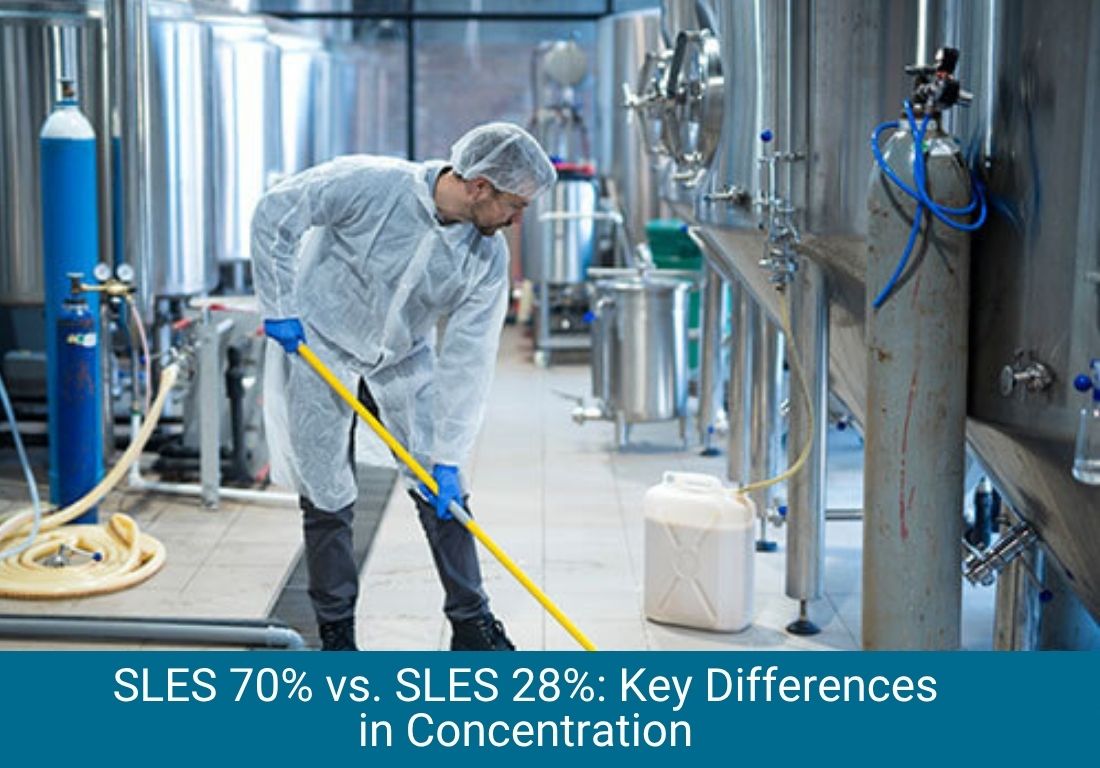
For large-scale manufacturers of shampoos, liquid soaps, detergents, and industrial cleaners who have the infrastructure to handle and dilute SLES 70%, the economic case is compelling. For smaller buyers or those without dilution capability, SLES 28% remains the more practical choice despite its higher landed cost per unit of active matter.
Read Our Article
Myristic Acid in Surfactants: Enhancing Formulation and StabilitySLES Uses: Where Is It Applied?
SLES uses span an exceptionally broad range of consumer and industrial applications, which is a primary reason why global demand for this surfactant remains robust and structurally growing year on year.
Personal Care and Cosmetics
SLES in shampoo formulations is perhaps its most visible application globally. It functions as the primary cleansing agent — generating the rich, dense foam that consumers associate with effective hair cleaning while being gentle enough for daily use across all hair types. Its mildness compared to SLS has made it the preferred primary surfactant in mainstream shampoo formulations worldwide.
SLES in body wash and shower gel formulations delivers the same combination of effective cleansing and skin-compatible mildness. Body washes represent one of the fastest-growing personal care categories in emerging markets across Asia, Africa, and Latin America — directly driving incremental SLES demand in these regions.
SLES in liquid soap — both hand wash and liquid hand soap formats — is another major application, with hygiene awareness driving sustained growth in both household and institutional (healthcare, food service, hospitality) markets globally.
SLES in cosmetics extends further to facial cleansers, makeup removers, bubble baths, and shaving gels — any rinse-off formulation where surfactant mildness and foam quality are important performance parameters.
Household and Industrial Cleaning
Beyond personal care, SLES uses in household cleaning include dishwashing liquids, laundry liquids, multipurpose surface cleaners, and bathroom cleaners. Its excellent grease-cutting performance, broad pH compatibility, and foam stability make it a versatile ingredient across cleaning product categories.
In industrial cleaning applications — including hard surface cleaners, institutional janitorial products, vehicle wash formulations, and textile processing — SLES 70% is valued for its high active concentration, which allows industrial formulators to achieve target surfactant levels efficiently and economically.
Oilfield and Industrial Applications
SLES finds application in oilfield chemicals as a foaming agent and emulsifier, in construction chemicals as a foam concrete additive, and in textile processing as a wetting and scouring agent. These industrial SLES uses represent a significant and often underappreciated share of global consumption.
SLES Benefits: Why Formulators Choose It
The enduring market dominance of SLES across so many application categories is not accidental — it reflects a combination of functional and commercial benefits that competing surfactants have struggled to match simultaneously.
Excellent Foam Generation: SLES produces abundant, stable, aesthetically pleasing foam — a critical performance attribute in consumer personal care and cleaning products where foam is directly associated with efficacy by end users.
Skin Mildness: The ethoxylation of SLES significantly reduces its skin irritation potential compared to SLS, making it suitable for daily-use personal care formulations including baby care products at appropriate concentrations.
Broad Compatibility: SLES is compatible with a wide range of co-surfactants, thickeners, conditioning agents, preservatives, and fragrance systems — giving formulators significant flexibility in building around it as a primary surfactant.
Cost Effectiveness: Relative to many alternative mild surfactants — such as betaines, sulfosuccinates, and amino acid-based surfactants — SLES offers significantly better cost performance, making it the economically rational choice as a primary surfactant in most mainstream formulations.
Regulatory Acceptance: SLES is approved for use in cosmetics and cleaning products across all major regulatory jurisdictions — EU, US FDA, India CDSCO, China NMPA, and others — simplifying compliance for formulators targeting multiple markets.
Our Other Products
Soap Noodles - SWSN, MSN, LSNSLES Price: What Drives Cost Fluctuations?
SLES price is determined by a layered set of upstream and market factors that buyers must understand to procure effectively.
Fatty Alcohol Feedstock Costs: The production of SLES begins with fatty alcohols — typically lauryl alcohol derived from coconut oil or palm kernel oil. Movements in coconut oil and palm kernel oil prices therefore flow directly through to SLES manufacturing costs. In periods of elevated lauric oil prices, SLES price rises correspondingly as producers pass through feedstock cost increases.
Ethylene Oxide Prices: The ethoxylation step in SLES production requires ethylene oxide — a petrochemical derivative whose price is linked to ethylene and ultimately to crude oil and natural gas markets. Volatility in energy and petrochemical markets therefore adds a second layer of price variability to SLES that is independent of vegetable oil markets.
Sulfur Trioxide Availability: The sulfation step in SLES production uses sulfur trioxide or oleum as the sulfating agent. Sulfur availability and pricing — linked to the global sulfur supply chain from petroleum refining — represent a third input cost variable.
Supply-Demand Balance: Global SLES manufacturing capacity is concentrated in China, India, Southeast Asia, and Europe. Chinese production capacity dominates global supply, and movements in Chinese production costs, export volumes, and domestic demand significantly influence international SLES price benchmarks. Any tightening of Chinese export availability — whether from environmental production curtailments, export policy changes, or domestic demand surges — can cause rapid SLES price increases in international markets.
Freight and Logistics: For buyers sourcing SLES 70% from Asian origins — particularly China and India — ocean freight rates and container availability directly affect the landed SLES price at destination. This has been a particularly significant factor since 2020, with shipping cost volatility adding meaningful price unpredictability to international SLES procurement.
How to Evaluate a SLES Supplier
Choosing the right SLES supplier is as important as understanding the product itself. For buyers sourcing SLES 70% bulk — whether for personal care manufacturing, detergent production, or industrial applications — the following evaluation criteria should guide supplier selection.
Active Matter Verification: Always request and verify the Certificate of Analysis (CoA) confirming active matter content at or above the stated 70% specification. Active matter below specification directly reduces the effective surfactant content of your formulation and increases per-unit production costs.
1,4-Dioxane Levels: A critical quality parameter for SLES used in personal care applications is 1,4-dioxane — a trace contaminant that can be present as a by-product of the ethoxylation process. Regulatory limits for 1,4-dioxane in cosmetics products vary by jurisdiction but are tightly controlled in the EU, US, and other regulated markets. Confirm that your SLES supplier tests for and can demonstrate compliance with applicable 1,4-dioxane limits for your target market.
Color and Odor Specifications: High-quality SLES 70% should be pale yellow to colorless with a mild, characteristic odor. Off-color or strong-odored product can indicate quality issues in the manufacturing process and may affect finished product appearance and fragrance stability.
Ethylene Oxide Moles (EO Content): Confirm that the product is SLES 2EO (2 moles ethylene oxide) unless your formulation specifically requires an alternative EO level. The EO content directly affects the mildness and performance characteristics of the surfactant.
Minimum Order Quantities and Packaging: SLES 70% bulk is typically available in ISO tank containers (for very large volumes), flexi-tanks, IBC totes (1,000 litres), and 200-litre drums. Confirm that your SLES supplier can supply in your preferred packaging format with appropriate lead times.
SLES 70% Global Trade: Key Sourcing Origins
Understanding where SLES is manufactured globally helps buyers make informed sourcing decisions and manage supply chain risk effectively.
China is the world's dominant SLES manufacturer, accounting for a large share of global production capacity. Chinese SLES suppliers offer highly competitive pricing and large-volume availability, making China the primary sourcing origin for buyers in Asia, the Middle East, Africa, and Latin America. Key production hubs include Zibo, Nanjing, and Guangzhou.
India is the second major sourcing origin, with a well-developed SLES manufacturing base serving both domestic demand — India's large and growing personal care and detergent industry — and export markets across the Middle East, Africa, and Southeast Asia. Indian SLES suppliers are particularly well-positioned for buyers seeking shorter lead times and smaller minimum order quantities than Chinese suppliers typically offer.
SLES commands a price premium but delivers the documentation and quality consistency demanded by regulated personal care brands.
Southeast Asia — Malaysia, Indonesia, and Thailand — has growing SLES production capacity, benefiting from proximity to lauric oil feedstocks and strong logistics infrastructure for serving Asian and Oceanian markets.
Our Other Products
Palm Kernel Fatty Acid DistillateBuying SLES 70% in Bulk: Practical Procurement Guidance
For buyers ready to buy SLES 70% bulk, the following practical steps will ensure an efficient and well-managed procurement process.
Define Your Specification First: Before approaching any SLES supplier, document your full technical specification — active matter minimum, pH range, color, viscosity, 1,4-dioxane limit, EO content, and any required certifications. A clearly written specification protects you from receiving non-compliant product and gives suppliers the information they need to quote accurately.
Request Samples Before Committing: For any new SLES supplier relationship, always request a commercial sample for laboratory evaluation before placing a bulk order. Evaluate the sample against your full specification and conduct formulation trials to confirm performance in your specific application.
Benchmark Multiple Suppliers: Obtain quotations from at least three SLES suppliers across different origins to benchmark SLES price competitiveness. Ensure quotations are on a comparable basis — same active matter specification, same packaging format, same Incoterms — to enable accurate comparison.
Build Inventory Buffer: Given the SLES price volatility driven by feedstock and freight market dynamics, maintaining a strategic inventory buffer — typically four to eight weeks of production consumption — provides protection against supply disruption and short-term price spikes without excessive working capital commitment.

Conclusion
SLES 70% is one of the most important surfactant raw materials in global trade — a chemically versatile, functionally powerful, and commercially indispensable ingredient that underpins the formulation of shampoos, body washes, liquid soaps, detergents, and industrial cleaners consumed by billions of people worldwide. Its combination of excellent foam performance, skin-compatible mildness, broad formulation compatibility, and cost effectiveness relative to alternative surfactants has made it the dominant primary surfactant in mainstream personal care and cleaning product manufacturing globally.
For buyers, the keys to successful SLES 70% procurement lie in specification clarity, rigorous supplier evaluation, active matter verification, appropriate quality certifications for target markets, and a proactive approach to managing the SLES price volatility that feedstock and freight market dynamics inevitably introduce. Working with established, transparent SLES suppliers who can demonstrate consistent quality, reliable supply capability, and full documentation support is the foundation of a procurement strategy that delivers both cost efficiency and product integrity.