Palmitic Acid vs. Stearic Acid: Comparison Analysis
When sourcing fatty acids for large-scale industrial applications, procurement decisions go beyond just price. Understanding the structural differences, processing compatibility and end-use performance of palmitic acid and stearic acid is critical for making the right sourcing choice. This comparative analysis helps industrial buyers evaluate both fatty acids across key parameters - from raw material origin to supply chain dynamics.
Palmitic Acid C16 and Stearic Acid: Understanding the Core Difference
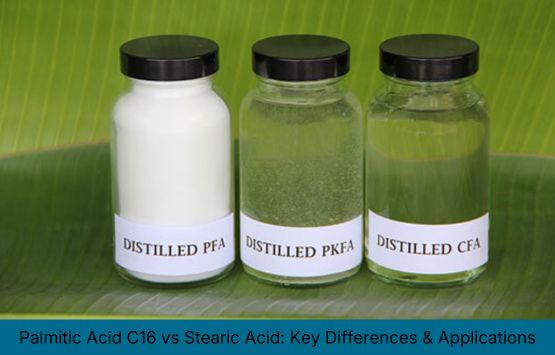
Palmitic acid, classified as a C16 saturated fatty acid and stearic acid, a C18 saturated fatty acid, are both derived from natural vegetable oils. The two-carbon chain difference between them directly influences their melting points, solubility and functional performance across industries. Palmitic acid (C16) has a lower melting point compared to stearic acid, making it more fluid at moderate temperatures. Stearic acid, on the other hand, offers greater hardness and higher thermal stability, which affects how each is used in manufacturing.
For industrial buyers, this structural distinction translates into distinct processing requirements, formulation outcomes and cost implications.
Palmitic Acid Market: Supply Chain and Sourcing Dynamics
The palmitic acid market is primarily driven by palm oil derivatives, with major production concentrated in Southeast Asia - particularly Malaysia, Indonesia and Thailand. These regions account for a dominant share of global palmitic acid supply, given the high palmitic content in palm stearin and palm kernel fractions.
Olivia Oleo Pte Ltd, sourcing directly from these palm oil-rich regions, operates as a key link in the global supply chain, connecting industrial buyers with reliable palmitic acid suppliers across Asia, Europe and beyond. Buyers benefit from consistent quality, traceable origin and competitive pricing when working with suppliers deeply integrated into Southeast Asian palm-based oleo chemical networks.
Global demand for palmitic acid is tied closely to growth in personal care, food processing, rubber and plastic compounding industries. Supply volatility can occur due to seasonal palm oil harvest variations and geopolitical factors in key producing countries, making long-term supplier partnerships a strategic priority for industrial procurement teams.
Palmitic Acid Uses in Industrial Manufacturing
Palmitic acid uses span a wide range of industrial sectors. In the personal care and cosmetics industry, it functions as a texturizing and emulsifying agent in creams, lotions and soaps, contributing to skin feel and product stability. In the food industry, it is used as a food-grade emulsifier and surface coating agent, particularly in bakery and confectionery manufacturing.
In rubber and plastics compounding, palmitic acid acts as an activator in vulcanization processes, improving the efficiency of accelerators. It also finds application as a release agent and lubricant in polymer processing. The oleo chemical sector further utilizes it in the production of metallic soaps, surfactants and fatty acid esters used across textile and paper processing.
Its relatively lower melting point compared to stearic acid makes it a preferred choice in formulations requiring easier melt handling and faster dispersion at processing temperatures.
Stearic Acid Market: Demand Trends and Industrial Relevance
The stearic acid market has seen consistent demand growth, driven largely by the rubber, plastics, cosmetics and candle manufacturing sectors. Like palmitic acid, stearic acid is predominantly sourced from palm oil fractionation and partially from tallow. Southeast Asian oleochemical hubs remain the primary production base for stearic acid exported globally.
Olivia Oleo Pte Ltd supplies stearic acid to international buyers sourced from Malaysian and Indonesian oleochemical manufacturers, ensuring consistent fatty acid profiles and compliance with international quality standards. The stearic acid market benefits from relatively stable raw material availability, though prices are influenced by upstream palm oil pricing trends.
Industrial demand from the rubber processing sector - where stearic acid is an essential processing aid and activator - remains one of the strongest growth anchors. Rising demand from the cosmetics industry, where it serves as a base ingredient in formulations, further supports market expansion.
Our Other Products
Soap Noodles - SWSN, MSN, LSNStearic Acid Uses: Where It Outperforms Palmitic Acid
Stearic acid uses are distinct in applications requiring higher melting points and greater hardness. In rubber compounding, stearic acid is used as a processing lubricant and vulcanization activator, where its C18 chain provides optimal dispersion and reactivity. It is widely preferred over palmitic acid in rubber manufacturing due to better compatibility with zinc oxide-based cure systems.
In candle manufacturing, stearic acid is a foundational ingredient - its higher solidification point and opacity-enhancing properties produce firmer, longer-burning candles compared to alternatives. In cosmetics and personal care formulations, it is used in stick products, bar soaps and emulsified lotions where structural firmness is a requirement.
Stearic acid also has significant use in the plastics industry as a lubricant and mold release agent and in metallic soap production - particularly zinc stearate and calcium stearate - which are used as heat stabilizers in PVC processing and as lubricants in powder metallurgy.
Read Our Article
Stearic Acid Grade ApplicationsPalmitic Acid Suppliers vs. Stearic Acid Suppliers: Sourcing Comparison for Buyers
For procurement teams, the choice between sourcing palmitic acid and stearic acid often comes down to application fit, but supplier evaluation criteria remain similar. Key parameters include fatty acid purity, iodine value, moisture content, color and free fatty acid content.
Both palmitic acid and stearic acid exporters in Southeast Asia operate within a competitive pricing landscape influenced by palm oil futures, freight costs and regional oleochemical production capacity.
When comparing the two, palmitic acid tends to be slightly more cost-competitive in markets where palm stearin is abundantly available. Stearic acid, requiring a more refined fractionation process, typically commands a modest price premium, though this varies with market conditions.
Palmitic Acid and Stearic Acid Manufacturers: Quality and Certification Standards
Industrial-grade fatty acid procurement requires adherence to recognized quality benchmarks. Palmitic acid manufacturers and stearic acid manufacturers in the oleochemical space typically certify products against RSPO, ISO 9001 and food-grade standards such as FCC (Food Chemicals Codex) or USP where relevant.
For buyers in the food, pharmaceutical and personal care sectors, certification traceability is a non-negotiable sourcing requirement. Olivia Oleo Pte Ltd facilitates buyer access to certified supply chains backed by third-party audit documentation, batch-specific COAs (Certificates of Analysis) and material safety data sheets aligned with international regulatory frameworks.
Our Other Products
Fractionated Fatty Acids
Conclusion
Choosing between palmitic acid and stearic acid depends on specific industrial application requirements, processing temperatures, formulation needs and supply chain priorities. Both fatty acids originate from the same Southeast Asian palm oil value chain, yet serve distinct end-use roles in rubber, cosmetics, plastics, food and oleochemical manufacturing. Olivia Oleo Pte Ltd bridges global industrial buyers with trusted palmitic acid and stearic acid suppliers across Malaysia, Indonesia and Thailand, offering consistent quality, certification support and competitive pricing tailored to procurement-scale requirements.