

The USA & Canada oleochemicals market continues to evolve as manufacturers refine product standards, optimize procurement strategies and demand tighter quality control from global exporters. From Triple Pressed Stearic Acid (TPSA) used in rubber and candles to High FFA CPO for biodiesel processing, from Betaine in personal care formulations to Vegetable Fat in food manufacturing, North America remains a performance-driven and specification-focused region. Buyers prioritize consistency, documentation discipline, transit stability and regulatory compliance.
For a Singapore-based exporter serving this region, understanding not just pricing trends but also application-based technical expectations is essential. Let’s break down product-specific demand patterns, quality parameters and market dynamics shaping the USA and Canada today.
Triple Pressed Stearic Acid Demand in USA & Canada for Rubber, Plastics & Compounding
Triple Pressed Stearic Acid plays a crucial role in rubber compounding and plastics processing across North America. In the USA, automotive tire manufacturers and industrial rubber processors account for a major portion of TPSA consumption. Canada, with its strong industrial and polymer sector, mirrors similar demand patterns, though at a slightly smaller scale.
In rubber applications, TPSA acts as an activator, lubricant and dispersion aid. The performance of zinc stearate formation in vulcanization systems directly depends on the purity and consistency of Triple Pressed Stearic Acid. Buyers typically look for low iodine value and controlled acid value to ensure process stability. Even minor variations in fatty acid composition can affect compound performance, so quality uniformity is not negotiable.
Plastics and compounding industries use TPSA as a mold release agent and processing aid. Here, melting behavior and color become important, especially in light-colored polymer products. USA buyers, in particular, request strict documentation and batch consistency reports. Canadian buyers often focus more on supply reliability due to seasonal logistics challenges, especially during winter months.
In both markets, long-term contracts are common, but spot buying increases when feedstock volatility affects pricing. For exporters, offering technical documentation along with sample validation builds trust in this performance-sensitive segment.
Triple Pressed Stearic Acid for Candle & Wax Blends in North America: Melting Point and Hardness Expectations
The candle industry in North America has witnessed strong growth, especially in premium, scented and decorative segments. Triple Pressed Stearic Acid is widely blended with paraffin and vegetable waxes to improve hardness, opacity and burn time.
In the USA, boutique candle brands often require higher melting point grades to maintain structural stability in warmer climates such as Texas and California. Canada, facing colder ambient temperatures, still demands stable crystallization behavior to prevent surface cracking during storage transitions.
Melting point typically ranges between 54–57°C or higher, depending on application. Candle manufacturers carefully monitor this parameter because it influences burn characteristics and finish quality. Acid value and color (Lovibond scale) are also critical. Excess color can alter pastel candle tones, something premium brands actively avoid.
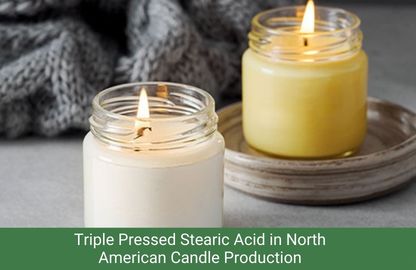
Consistency is everything in this segment. Even slight batch-to-batch deviation can result in visible texture differences. North American buyers increasingly request laboratory test reports before approving shipments. Reliable packaging, especially in 25 kg bags with moisture barriers, prevents contamination during long transit from Asia to ports like Los Angeles, Vancouver or Houston.
Triple Pressed Stearic Acid Quality Specs for USA/Canada Buyers: Iodine Value, Acid Value, Color, Moisture
When supplying Triple Pressed Stearic Acid to the USA & Canada oleochemicals market, specification clarity determines approval speed. Buyers expect iodine value within tightly controlled limits, typically below 1.0 for high-purity grades. Lower iodine value indicates better saturation and oxidative stability.
Acid value reflects purity and must align with industry expectations, usually around 205–210 mg KOH/g. Color, often measured in Lovibond units, should meet the buyer’s visual requirements, particularly for cosmetic or candle applications. Moisture content must remain minimal to avoid caking and processing complications.
Documentation discipline matters just as much as technical specs. Certificates of Analysis (COA), MSDS and batch traceability are mandatory. USA importers may also conduct third-party inspections before shipment. Canadian importers often emphasize bilingual labeling compliance and customs clarity.
Clear communication regarding specification ranges reduces disputes and strengthens long-term relationships. In this region, technical reliability often outweighs marginal price differences.
Triple Pressed Stearic Acid Supply Chain to USA & Canada: Packaging, Shelf-Life and Container Handling
Shipping Triple Press Stearic Acid requires careful container planning. Most shipments move in 20-foot containers with palletized 25 kg bags or jumbo bags for bulk buyers.
Shelf-life typically extends up to two years when stored in dry, cool conditions. However, humidity exposure during ocean transit can affect product flowability. Moisture-resistant packaging and proper container lining reduce this risk.
USA ports such as Houston and New York handle large volumes, while Canadian imports frequently enter via Vancouver and Montreal. Winter temperatures in Canada demand attention to condensation management. Exporters often include desiccant packs to control moisture buildup.
Lead times vary between 30–45 days depending on shipping routes. Clear freight coordination and real-time tracking improve buyer confidence. Efficient logistics often become a deciding factor in repeat contracts.
High FFA CPO Use Cases in USA & Canada: Biodiesel, Oleochemicals and Industrial Processing
High FFA CPO (Crude Palm Oil with elevated free fatty acid content) serves specialized industrial sectors in North America. In the USA, biodiesel producers use High FFA CPO as a feedstock where esterification processes convert free fatty acids efficiently. Industrial oleochemical exporters also utilize it for fatty acid distillation.
Canada’s biodiesel blending mandates support periodic demand spikes, particularly in provinces with renewable fuel requirements. Buyers evaluate FFA levels carefully, typically ranging between 5% and 20% depending on processing capability.
Industrial users appreciate cost advantages compared to refined grades. However, processing efficiency depends on moisture and impurity control. High FFA CPO must remain stable during transit to avoid excessive oxidation.
Clear understanding of the end application helps exporters recommend the correct grade. Technical transparency encourages repeat orders in this price-sensitive segment.
High FFA CPO Buying Specs for North America: FFA Range, Moisture, Impurities and Stability
North American buyers specify exact FFA ranges to match their esterification or refining setup. Moisture and impurities (M&I) are usually required below 0.5% to ensure efficient processing. Higher moisture leads to soap formation and yield loss.
Peroxide value and oxidation stability are increasingly monitored, especially during long shipments. Buyers expect consistent tank cleanliness and proper sampling procedures before loading.
COA discipline is strict. Each shipment must reflect tested parameters and discrepancies can delay unloading. For a Singapore-based exporter, pre-shipment inspection ensures smoother customs clearance.
Our Other Products
Fatty AlcoholHigh FFA CPO Storage & Oxidation Control for USA/Canada: Preventing Quality Loss in Transit
Temperature fluctuations during ocean freight can accelerate oxidation. Using insulated ISO tanks or well-maintained flexitanks reduces exposure. Nitrogen blanketing is sometimes applied for higher-value cargoes.
Upon arrival in the USA or Canada, immediate discharge into temperature-controlled storage preserves quality. Buyers often monitor acid value changes post-arrival to assess transit performance.
Logistical discipline reduces claims and strengthens long-term partnerships in this bulk commodity trade.
High FFA CPO Import Compliance & Documentation for USA & Canada: Traceability and COA Discipline
Import compliance includes proper HS code declaration, phytosanitary documentation where applicable and clear origin statements. The USA places strong emphasis on traceability documentation, while Canada requires thorough customs documentation aligned with federal import rules.
COA accuracy builds credibility. Any mismatch between declared and tested values can cause demurrage costs. Professional exporters maintain digital documentation systems to ensure seamless paperwork flow.
Betaine Demand in USA & Canada Personal Care: Mild Surfactant Blends for Shampoos and Cleansers
Betaine, particularly Cocamidopropyl Betaine, plays a central role in North American personal care formulations. Demand continues to grow in sulfate-free shampoos and gentle cleansers.
USA consumers increasingly prefer mild formulations with stable foam performance. Betaine enhances viscosity and reduces irritation potential when blended with anionic surfactants. Canadian brands follow similar formulation strategies, especially in baby-care products.
Large contract manufacturers require consistent active matter content and low residual impurities. Supply continuity matters, as production schedules operate on tight timelines.
Betaine in North America: Trends in Sulfate-Free, Sensitive-Skin and Baby-Care Formulations
Product developers across the USA and Canada are reformulating to meet consumer expectations for gentle cleansing systems. Betaine supports foam stability without aggressive stripping.
Sensitive-skin lines depend on balanced pH and low color levels. Transparency and clarity influence visual appeal in clear shampoos and body washes. As branding becomes more ingredient-focused, quality assurance from suppliers becomes critical.
Reliable exporters support innovation by providing stable viscosity and repeatable quality parameters.
Read Our Article
Oleochemicals Scientific & Industrial Research, Process OptimizationBetaine Quality Parameters for USA & Canada Buyers: Active Matter, Clarity, Color, pH, Salt Content
Active matter content typically ranges around 30%. Buyers monitor salt content because it influences final product thickness. pH stability ensures compatibility with other surfactants.
Clarity and low color index are vital for premium personal care brands. Even slight haze may lead to rejection. Laboratory testing before dispatch reduces risk of disputes.
Betaine Supply Models for USA & Canada: Drums/IBCs, Lead Times and Consistent Viscosity
Betaine is usually supplied in HDPE drums or IBC tanks. Large manufacturers prefer bulk IBC shipments to optimize handling efficiency. Lead times average 4–6 weeks.
Viscosity stability during cold Canadian winters requires careful storage guidance. Exporters provide temperature management instructions to prevent thickening during transit.
Vegetable Fat Demand in USA & Canada Food Manufacturing: Bakery, Confectionery and Frying
Vegetable Fat remains integral to North American food production. Bakery shortenings, confectionery coatings and frying mediums all depend on tailored fat profiles.
USA bakeries prioritize performance consistency, especially in large-scale industrial bread and pastry production. Canadian confectionery manufacturers demand specific melting curves for chocolate alternatives.
Slip point, solid fat content (SFC) profile and peroxide value define product acceptance. Food safety compliance and labeling readiness are mandatory.
Vegetable Fat for Industrial Use in North America: Soap, Cosmetics and Oleochemical Inputs
Beyond food, Vegetable Fat supports soap noodles production and cosmetic bases. Industrial users evaluate fatty acid composition and processing stability.
Soap manufacturers in the USA often integrate vegetable-derived inputs to maintain bar hardness and foam characteristics. Canadian industrial processors focus on uniformity and predictable saponification values.

Vegetable Fat Specs for USA & Canada: Slip Point, SFC Profile, Peroxide Value, Trans-Fat Compliance
North American buyers expect strict trans-fat compliance aligned with regulatory requirements. Slip point must match intended application temperature range. SFC profile influences mouthfeel in edible applications and hardness in industrial uses.
Peroxide value indicates oxidation level and must remain low for food-grade material. Exporters who maintain robust refining and testing systems gain stronger acceptance.
Vegetable Fat Import Strategy for USA & Canada: Application-Based Grade Selection and Labeling Readiness
Importers carefully align grade selection with final product claims. Food-grade shipments require proper labeling, allergen statements where applicable and regulatory documentation.
Strategic freight planning minimizes storage costs at destination ports. Working with experienced freight forwarders ensures smoother entry into North American supply chains.
USA & Canada Buyer Checklist for TPSA, Betaine, Vegetable Fat and High FFA CPO: COA, Traceability, Packaging
Buyers across the USA & Canada oleochemicals market follow structured evaluation criteria:
- Verified COA with batch numbers
- Clear traceability documentation
- Proper packaging integrity
- Stable transit performance
- Regulatory compliance paperwork
Meeting these expectations consistently builds long-term partnerships.
Our Other Products
Distilled Coconut Fatty AcidUSA vs. Canada Market Differences: Where Demand is Stronger for TPSA, Betaine, Vegetable Fat and High FFA CPO
The USA represents a larger volume market overall due to scale of manufacturing. TPSA demand is particularly strong in American rubber and plastics industries. Betaine consumption is high in both markets, though niche premium brands are growing faster in Canada.
Vegetable Fat demand in food manufacturing is substantial in both countries, while High FFA CPO sees stronger activity in the USA biodiesel sector due to larger processing capacity.
Understanding these subtle differences allows exporters to tailor strategies rather than treating North America as a single uniform market.
How Olivia Oleo Supports TPSA, High FFA CPO, Betaine and Vegetable Fat Sourcing Across North America
Olivia Oleo Pte Ltd, headquartered in Singapore, delivers value across palm oil and its derivatives with a management team bringing over three decades of market experience. The company combines market intelligence, competitive freight solutions and disciplined quality control to serve global buyers efficiently. Its portfolio includes key oleochemicals and cater various products such as fatty acids, soap noodles, refined glycerine, Cocamidopropyl Betaine, Sodium Lauryl Ether Sulphate, Crude Palm Oil, RBD Palm Olein, vegetable shortening and hydrogenated palm kernel oil. Through streamlined supply chain management, consistent product recommendations and responsive customer service, Olivia Oleo supports clients in navigating market cycles while ensuring reliable delivery performance across regions including the USA and Canada.
Conclusion
The USA & Canada oleochemicals market demands precision, consistency and strong documentation across TPSA, High FFA CPO, Betaine and Vegetable Fat segments. Buyers prioritize defined specifications, reliable transit performance and application-focused grade selection. While the USA leads in volume and industrial scale, Canada shows steady growth in specialty and premium formulations. Exporters who combine technical clarity with disciplined logistics gain a clear competitive edge. In this performance-driven region, long-term success depends on quality stability, compliance accuracy and responsive supply chain execution.