

Hydrogenated Palm Oil Explained: From Trans-Free Margarine to Confectionery Fats and Industrial Applications
Hydrogenated Palm Oil is one of the most technically specific products in the palm oil derivatives range, produced through a controlled catalytic reaction that converts unsaturated fatty acid bonds into saturated ones and fundamentally changes the fat's melting point, oxidative stability, and functional properties. It is widely used in trans-free margarine and shortening production, confectionery filling fats, and industrial applications where a fully saturated, high-melting hard fat is required. Yet it is frequently misunderstood, particularly in its relationship to regular RBD Palm Oil, to non-hydrogenated palm oil fractions, and to Hydrogenated Palm Kernel Oil, which has an entirely different fatty acid profile and application set. This article clarifies the hydrogenation process, explains the functional differences between hydrogenated and non-hydrogenated palm oil, and identifies the key applications and buyer considerations for each variant.
What Is Hydrogenated Palm Oil and How Does the Hydrogenation Process Work?
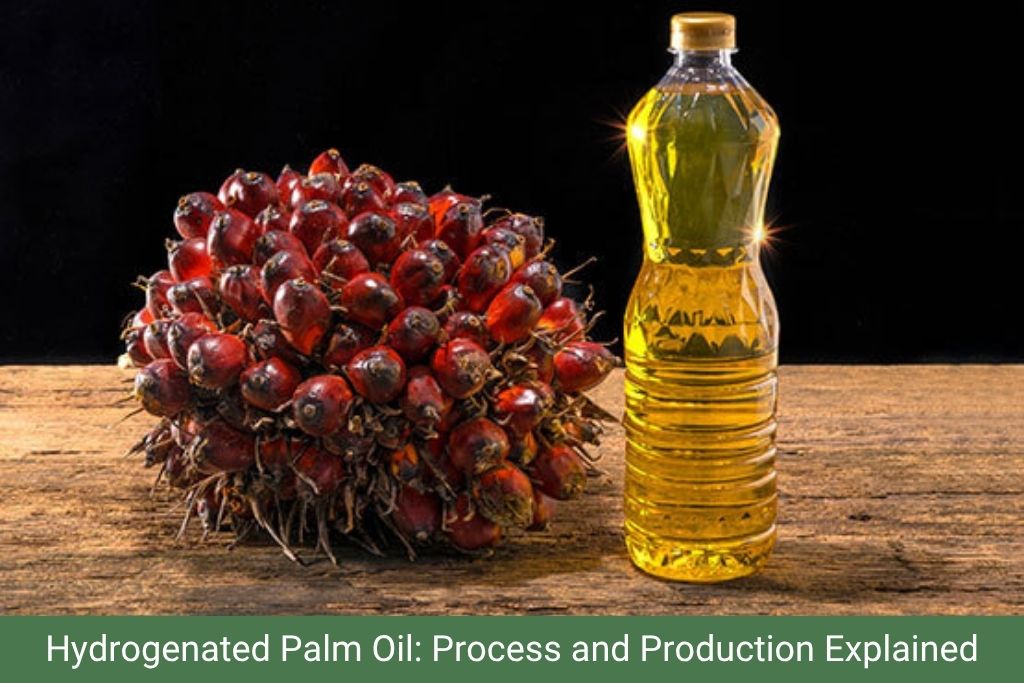
Hydrogenated Palm Oil is produced by reacting palm oil with hydrogen gas in the presence of a nickel catalyst under elevated temperature and pressure. The hydrogenation of palm oil converts unsaturated double bonds in the fatty acid chains into saturated single bonds, which increases the melting point and reduces the iodine value of the fat. The degree of hydrogenation determines whether the result is partially or fully hydrogenated palm oil. Partial hydrogenation, which converts only some of the double bonds, raises the melting point moderately and was historically used to produce solid fats for margarine and shortening, but it is now largely avoided in food applications due to the formation of trans fatty acids as a byproduct of incomplete hydrogenation. Full hydrogenation converts all double bonds and produces a completely saturated fat with no trans fatty acids and a very high melting point, typically above 58 degrees Celsius for fully hydrogenated palm oil. The resulting product is often subsequently blended, fractionated, or interesterified to achieve the desired functional properties for specific end uses.
What Is the Difference Between Hydrogenated Palm Oil and Regular Palm Oil?
Regular palm oil, in its RBD (Refined, Bleached, Deodorised) form, has a natural melting point of approximately 33 to 39 degrees Celsius and an Iodine Value of 50 to 55. It is semi-solid at room temperature in temperate climates and liquid above 40 degrees Celsius. Hydrogenated Palm Oil has a significantly higher melting point - typically 56 to 64 degrees Celsius for fully hydrogenated grades - and an Iodine Value close to zero, meaning it is completely solid and waxy at room temperature in all climates. Regular palm oil retains some oleic acid (approximately 40 percent) which confers moderate oxidative stability. Palm oil hydrogenated to full saturation has essentially no unsaturation remaining, giving it exceptional oxidative stability and a long shelf life without the need for antioxidant additives. The hydrogenated palm oil vs palm oil comparison therefore comes down to: regular palm oil is a semi-solid multipurpose fat suitable for frying and margarine; hydrogenated palm oil is a hard, high-melting speciality fat used where a firm, stable, fully saturated fat is required by the application.
Our Other Products
Soap Noodles - SWSN, MSN, LSN
What Are the Main Applications of Hydrogenated Palm Oil?
Hydrogenated Palm Oil serves specific functions in both food and industrial applications where its high melting point and full saturation are technically required. In vegetable fat-based products, fully hydrogenated palm oil is used as a hard stock in the production of trans-free margarine and shortening when blended via interesterification with liquid oils such as palm olein or sunflower oil. Interesterification with fully hydrogenated palm oil produces a randomised triglyceride structure that has the plastic texture of traditional partially hydrogenated fats without the trans fat content. In confectionery, hydrogenated palm oil is used in filling fats, wafer cream fillings, and hazelnut spreads where a firm, non-greasy texture at room temperature is required. In industrial applications, fully hydrogenated palm oil is used as a release agent for baking moulds, as a lubricant in metal processing, and as a raw material for the production of fatty alcohols and fatty amines through further chemical processing.
Read Our Article
How Palm Oil Powers the Global Confectionery and Ice Cream Markets?What Is Non-Hydrogenated Palm Oil and Why Is It Growing in Demand?
Non hydrogenated palm oil refers to palm oil that has not been subjected to any hydrogenation treatment - either RBD Palm Oil or its fractions (Palm Olein and Palm Stearin) in their naturally processed form. The growing demand for non-hydrogenated palm oil is driven by the food industry's global shift away from trans fats following regulatory restrictions in the United States (FDA ban on partially hydrogenated oils since 2020), the European Union, Canada, and other major markets. Because non-hydrogenated palm oil is naturally semi-solid at temperate ambient temperatures and provides functional hard fat properties without requiring hydrogenation, it has become the preferred base fat for margarine, shortening, and bakery fat reformulations that previously relied on partially hydrogenated vegetable oils. For bulk buyers sourcing from Olivia Oleo, both hydrogenated palm oil and non-hydrogenated palm oil fractions are available with full documentation confirming the hydrogenation status of the product for regulatory compliance and labelling purposes.
How Does Hydrogenated Palm Oil Compare with Hydrogenated Palm Kernel Oil (HPKO)?
Hydrogenated Palm Oil and Hydrogenated Palm Kernel Oil are both fully saturated fats produced by the hydrogenation process, but they differ fundamentally in their fatty acid composition and applications. Hydrogenated palm oil is dominated by palmitic acid (C16:0) and stearic acid (C18:0), giving it a relatively high melting point but a non-lauric fat profile. HPKO is dominated by lauric acid (C12:0) from the palm kernel feedstock, and it is precisely this lauric acid content - after full hydrogenation - that gives HPKO its exceptionally sharp melt profile near body temperature, making it the preferred fat for CBS (Cocoa Butter Substitute) production and confectionery coatings. Hydrogenated palm oil does not exhibit this sharp melting behaviour and is not used in confectionery coating applications where a clean melt is required. For soap manufacturing, both fats contribute to bar hardness but through different fatty acid chains, with hydrogenated palm contributing C16 palmitate hardness and HPKO contributing C12 laurate hardness to the soap structure.
Our Other Products
Distilled Fatty Acids
Hydrogenated Palm Oil: Matching the Right Specification to Your Application and Regulatory Market
Hydrogenated Palm Oil serves a specific technical function in formulations that require a fully saturated, high-melting hard fat with exceptional oxidative stability and no trans fatty acid content. Whether your application is trans-free margarine production via interesterification, wafer cream filling fats, baking release agents, or industrial lubricants, the correct specification of fully hydrogenated palm oil needs to be matched to your precise process requirements. For buyers where non-hydrogenated palm oil is the preferred option for regulatory compliance in trans-fat restricted markets, Olivia Oleo supplies both hydrogenated and non-hydrogenated palm oil fractions with full documentation confirming hydrogenation status for labelling and regulatory purposes. Contact Olivia Oleo to request specifications, samples, and pricing for your hydrogenated palm oil requirement.